
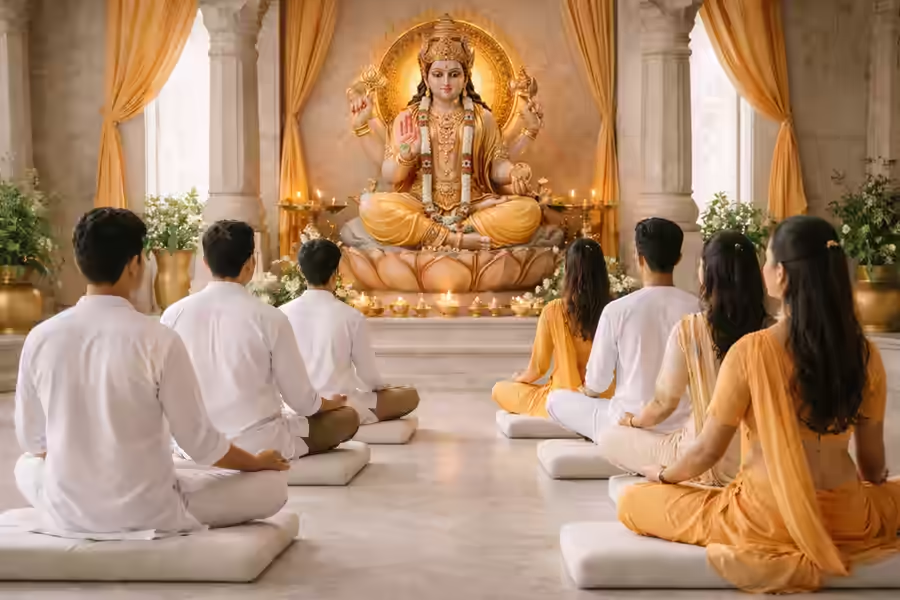
Spiritual tourism is flourishing in India, drawing both domestic and foreign visitors. Millions of people come to major events like Diwali and Kumbh Mela in search of spiritual experiences. Spiritual tourism, which offers both cultural diversity and economic prosperity, makes a substantial contribution to India’s GDP because to improvements in transportation and the expansion of the hotel sector.
By itself, the term spirituality is comprehensive and contains the secret of contentment. An average individual may never need to rely on other people or materialistic things to be happy and lead a fulfilled life if they properly comprehend and interpret what it means to be spiritual.
Being the best version of oneself ultimately boils down to the spiritual awakening of the mind. And a sizable portion of the world’s population is traveling to India, the origin of yoga and Ayurveda, the center of spirituality, and the finest place to obtain moksha, in order to reach this mental condition.
Religious and spiritual travel
Isn’t it lovely that people are coming to India from all over the world to find spirituality or peace? You might be shocked to learn that religious and spiritual travel accounts for almost 60% of India’s tourism. The Ministry of Tourism reports that 1,433 million domestic tourists traveled to different pilgrimage sites throughout the nation in 2022.
The well-known social reformer, motivational speaker, and author Gauranga Das Prabhu Ji discussed past and current trends, saying, “People used to travel only for tourism and relaxation, but now the shifting trend is to travel for inner fulfillments and spiritual awakenings. People want to travel to important spiritual locations for the same reason, such Jerusalem in Israel, Mecca in Saudi Arabia, or Varanasi or Vrindavan in India.
The journeys of famous individuals like Adi Shankara, who traveled around the subcontinent to create mathams that still exist today, inspired the deep, historic roots of spiritual tourism in India. In the past, pilgrims traveled great distances from Kanyakumari to Kashmir and Badrik Ashram, enduring hardships that have been remembered for generations.
There are at least 51 holy pilgrimage sites in South Asia for the Shakta tradition alone, including places like Hinglaj in Pakistan that continue to draw followers. Transportation improvements have made spiritual tourism more widely available, enabling more people to visit these hallowed locations, providing a profound sense of inner fulfillments and boosting the local economies of these spiritual centers.
The expansion of the hotel sector, spiritual tourism, and India’s GDP are all directly correlated. India offers a huge terrain for individual enlightenment and mindfulness since it is a melting pot of cultures and a treasure trove of religious heritage. With 9% of India’s GDP coming from tourism, the rise of spiritual tourism offers a special chance to advance both economic prosperity and cultural diversity.
Gen Z using spirituality to cope
According to the same Pew survey, the number of Muslims, who make up more than 14% of Indians, increased while the number of Hindus worldwide, 95% of whom reside in India, where they make up 80% of the population, remained constant.
India’s youth, who make up 65% of the country’s population, appear to be rediscovering religion and spirituality, in contrast to many other countries. However, they are carrying it out in a unique manner.
According to a YouGov-Mint survey, 62% of India’s Gen Z, or those born roughly between 1997 and 2012, routinely pray, and 53% of them think religion is important.
According to a 2021 MTV Youth Study, 62% of Gen Z in India think spirituality gives them clarity. After praying, about 70% reported feeling more self-assured.
“Gen Z has a lot of different vocabulary that they can lean on to explain what they are feeling, which is different from previous generations,” Manavi Khurana, a counseling psychologist, told DW.
phrases like self-discovery, grounding, and healing. Despite their intersections, spirituality, religion, wellness, and well-being are sometimes confused. Khurana continued.
She founded Karma Care, a mental health organization in Delhi that serves a mix of Gen Z and Millennial clients (those born roughly between 1981 and 1996).
Fewer rituals, more personalization
Surya, a 27-year-old influencer and lone wanderer, has over 290,000 Instagram followers. Her travels are frequently spiritual in nature.
Surya has visited several significant Hindu pilgrimage sites and festivals, such as the Haridwar Kumbh in 2021, Kedarnath, and the Kumbh Mela in Prayagraj this year.
Spiritual content on social media
Some critics claim that because social media plays such a significant part in young people’s interest in and involvement with spirituality, the experience is less genuine or staged.
Although there might be some truth to this, according to psychologist Khurana, it does not render the youth’s connection to spirituality or religion inauthentic.
“Just because a lot of Gen Z communicate via Instagram or the internet and that is their way of community, we can’t totally write it off as performative,” she stated, noting that younger generations were “brought up around phones and raised by technology.”
The youth of the nation are drawn to yoga, meditation, astrology, and even spiritual leaders and speakers who use relevant language.
“Just because a lot of Gen Z communicate via Instagram or the internet and that is their way of community, we can’t totally write it off as performative,” she stated, noting that younger generations were “brought up around phones and raised by technology.”
Also Read: How Can We Clean Up Space Junk and Protect Earth’s Orbit from Debris
The youth of the nation are drawn to yoga, meditation, astrology, and even spiritual leaders and speakers who use relevant language.