
Despite the current ceasefire efforts between Iran and the United States, the United Arab Emirates has become one of the main targets of the Iranian missile and drone attacks. This state of affairs has cast a dark shade on the reasons as to why the Tehran has persisted in knocking out a major Gulf nation despite the attempts by the international community to de-escalate the situation.
The solution is in a combination of geography, geopolitics and economic strategy and the UAE is the key pressure point in the current conflict.
The Strategic Position of UAE predisposes it to the vulnerability
One of the biggest reasons is geography. The UAE is a target that is easily accessible by missiles and drones due to its proximity to Iran, which is located on the other side of the Persian Gulf.
And the distance is not the only reason why attacks are more intensive. The UAE has also emerged as one of the most globally linked economic centres in the region. Ports, airports, and oil terminals are important infrastructure that takes place in the global trade and supply of energy.
The Iranian strikes have been reported to hit key locations such as the oil terminal at Fujairah and the most important transport hubs as a way of disrupting economic activities and sending a broader message to the global markets.
Economic Giant Coming under Fire
The emergence of the UAE as a financial, logistic, and tourist centre has made it strategically significant not only to the region but also to the whole world. This also renders it to be a high-value target.
Iran is trying to exert economic pressure not only on the UAE, but on the international system as a whole, which relies on it.
According to experts, an attack on such hubs can have ripple effects on the international markets, affecting the oil supply chains, investments and trade routes.
Presence of US Military is a Major Factor
The other significant cause is the fact that the UAE is a close partner to the United States. There are significant US military bases in the country, such as Al Dhafra Air Base.
Iran has made it clear severally that any place hosting or aiding US military activities can be seen as a legitimate target in conflict. This puts the UAE in the straight line of attack.
To Tehran, attacking such sites is just a part of a greater plan to attack the influence of the US in the region.
Increasing Ties With Israel.
The UAE getting close to ties with Israel has brought another dimension to the conflict.
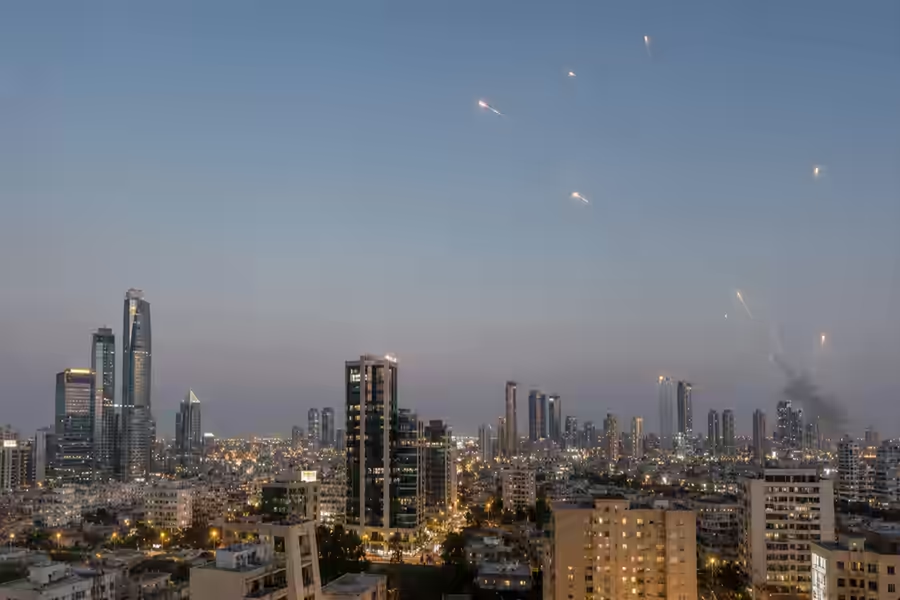
Since the Abraham Accords in 2020, the two countries have increased their relationship in the defence, intelligence and technology fields. It was even reported that advanced defence systems such as Iron Dome support were deployed in the UAE during the conflict.
This convergence has made Iran consider UAE as being in a wider coalition against it, which has made it more likely to be attacked.
In Name, Conflict on Ground, ceasefire
Although there can be a ceasefire on paper, the reality on the ground is much more frail. The fact that the strikes continue to show that there are some tensions that have not been resolved.
The approach of Iran seems to be based on the preservation of pressure but does not imply the full-scale escalation. It is a message by attacking particular targets in the UAE that it does not go directly against larger powers with its head held up.
Greater Context: A Mid-Atlantic Power Game
The attacks are not accidental they are part of a broader geopolitical conflict between Iran, the US, Israel and the Gulf countries.
This conflict has put the UAE in the centre of this conflict due to its position as a world hub and its alliances. As far as these background problems exist, ceasefires can be of only temporary help.
The situation as it stands today throws light on a bitter truth that, in the current conflicts, economic and strategic resources hold just as much weight as military targets, and that such nations as the UAE are on the front line even without necessarily fighting in a war.
Also Read: