
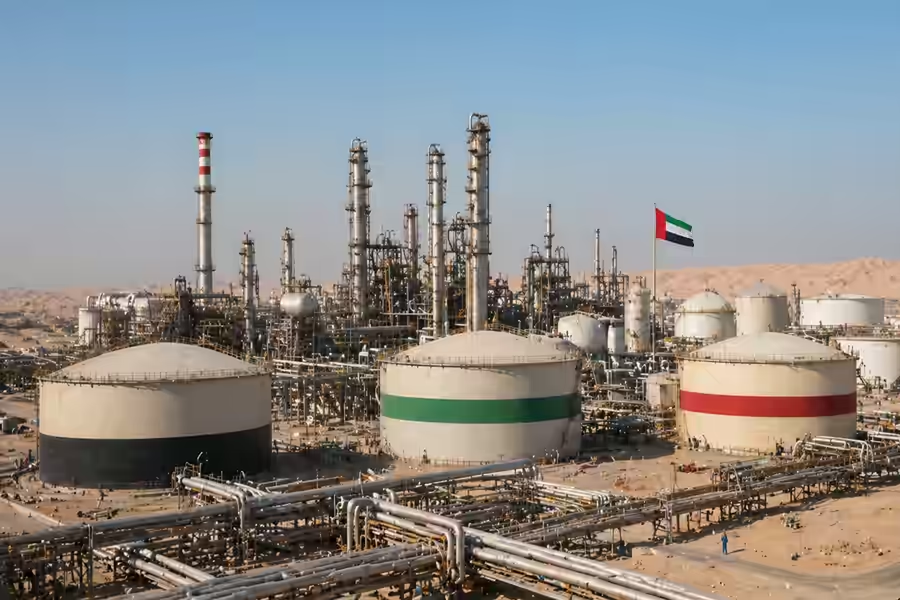
The United Arab Emirates has voted to leave the OPEC after close to 60 years of membership in a move that may redefine the world oil politics. Although the move is well-grounded economically, it is also based on the expanding geopolitical tensions namely with Saudi Arabia and the changing dynamics of the region, featuring Pakistan.
The move is one of the most radical changes in the history of the oil cartel, and may undermine the power of OPEC to dictate the supply of the world crude oil.
Why UAE decided to withdraw
The disagreement over the limits of production is a long-standing dispute at the heart of the decision. The UAE, which is one of the largest producers in OPEC, has been demanding more production, whereas Saudi Arabia, the de facto leader of the group, has favoured a more restrictive production to stabilize prices.
This contrast has become even more accentuated in recent years. OPEC quotas are of the view that the UAE is underutilising its production capacity and thus is not able to maximize its revenue at the time when the world is uncertain about its demand.
By going outside, Abu Dhabi will have the total control of its output strategy in oil. It is now able to produce without any limit and react faster to market changes.
The Tensions in Saudi Arabia are more than oil
The dispute is not only regarding barrels of oil. The UAE and Saudi Arabia have also been on the other side of a number of regional problems such as West Asian conflicts.
Although there has been an overlap of interests between the two countries concerning Iran, their interests have not always been similar. It has been reported that the UAE has been more aggressive and demanded coordinated responses, whereas Saudi Arabia has adopted a more cautious approach in some cases.
This absence of concerted action in the Gulf has increased the strategic divide between the two states.
The Pakistan Angle of the Rift
Another reason why the UAE is frustrated is the involvement of Pakistan in regional politics. Islamabad has tried to become a mediator between the US and Iran, which has not augured well with Abu Dhabi.
The UAE point of view is that it is unacceptable to be neutral in a conflict that involves the security of the Gulf. This is also compounded by the fact that Pakistan is having close defence relations with Saudi Arabia, which enhances the power of Riyadh in the region.
In another significant step in the past, the UAE is said to have pulled out billions of dollars of deposits in Pakistan indicating its discontents. This further complicated the already tense relationships in the Gulf bloc.
What UAE will benefit with this exit
Quitting OPEC would enable the UAE to be an energy power on its own instead of being a part of an integrated team. The country hopes to increase its production substantially over the next few years and gain more influence in the global energy markets.
It also puts the UAE in closer relation to the United States where the leaders have frequently criticised the role of OPEC in regulating oil prices.
The relocation is a strategic move that makes Abu Dhabi flexible, economically and diplomatically, at a time when the world is witnessing changing alliances.
Effects on Global Oil Market and India
The move can have global implications. As the UAE is free to supply more, world oil supply can increase, which can lead to a decrease in price in the long run.
In the case of India, which is one of the biggest oil importers, this may mean less cost of imports and less inflationary pressure. The ability to have a more flexible supply environment also enhances energy security of countries that rely on crude imports.
In the immediate though, volatility can be expected as markets adapt to the new dynamics and geopolitical tensions still affect the prices.
A Turning Point of OPEC
The UAE quitting is not merely a change of policy it is an indication of fissures in internal cohesiveness of OPEC. When other members start to oppose the limits of production or strategic direction, the cartels grip on the world oil markets might be further diluted.
At this point, the UAE seems to be willing to forge its own course, a balance between economic ambitions and geopolitical positioning. The way in which this decision redefines relationships in the Gulf and even beyond will become apparent in months to come.
Also Read: