

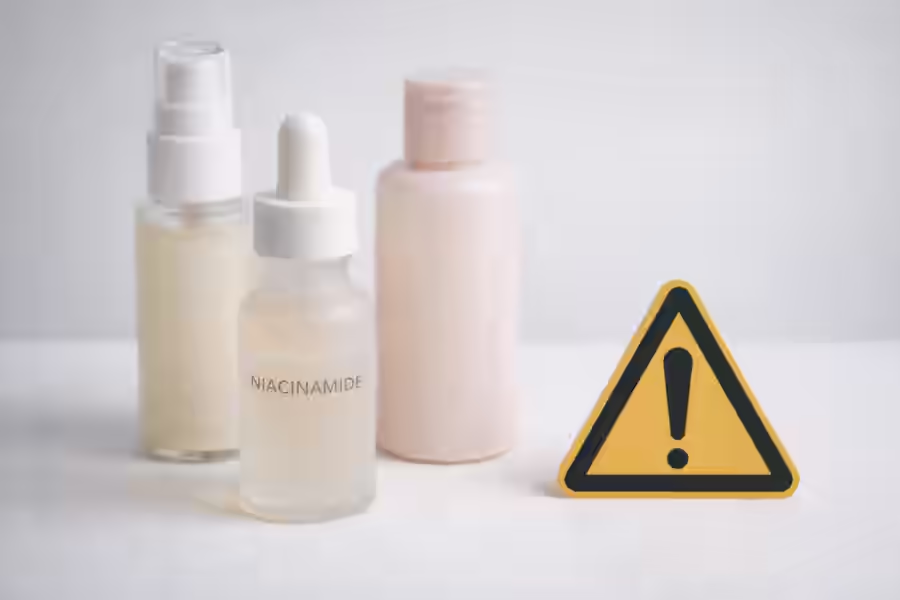
Niacinamide or Vitamin B3 has been hailed as one of the most trusted multitaskers in skincare since time immemorial. It is acclaimed to perfect the look of pores, balance oils, discolour pigmentation, reduce inflammation and fortify the skin barrier. In recent years it was a celebrity ingredient in serums, moisturizers, toners and even cleansers, and 10 percent formulations are now commonly sold as the key to clear, glowing skin in a few weeks.
Nevertheless, dermatologists are overhearing more individuals with unexpected redness, irritation and breakouts that are not associated with harsh actives such as retinoids or exfoliating acids, but with Niacinamide itself.
This new phenomenon has been informally referred to as Niacinamide fatigue, and the experts blame the issue more on the frequency and intensity of the layering rather than on the ingredient itself.
The crux of the matter is what the experts refer to as inadvertent piling up. Since Niacinamide is stable and most people can tolerate it, it has been used in many daily products by cosmetic companies.
A common regimen could also consist of a Niacinamide-impregnated cleanser, a toner with the same ingredient, a specific high-strength serum, and a moisturizer and sunscreen with this ingredient also listed among the key ingredients. Each product individually might appear gentle. When combined, they can drive total exposure much beyond the actual requirements of the skin.
Medical studies indicate that Niacinamide is most effective at 2-5 percent. In this spectrum, it assists in enhancing barrier activity, decreasing water loss and calming inflation. Overlapping products can reach cumulative concentrations upward of 15 or 20 percent.
When levels are this high, rather than strengthening the barrier, the ingredient may saturate and cause irritation and sensitivity.
The so-called redness paradox is one of the most bewildering elements of the users. Niacinamide has anti-inflammatory effects, which is why a significant portion of the population will resort to it specifically to address reactive skin. But in large quantities, it may induce the reverse. Dermatologists attribute this reaction to several mechanisms.
The first is a histamine reaction. Vitamin B3 derivatives can cause histamine release at the skin at high levels. In people with sensitive or reactive complexions, it may lead to itching, blotchiness and small, rash like bumps, which may resemble mild contact dermatitis.
The possibility of flushing is another determinant. Although it is generally stable, Niacinamide may change to niacin, or nicotinic acid, under some conditions. This is most likely when it is overlapped with low pH products like strong Vitamin C in the form of L-ascorbic acid or by strong exfoliating acids like glycolic acid.
Niacin may cause a sudden feeling of warmth on the surface of the skin, as well as reddening of the skin, which is called a niacin flush.
Lastly is the problem of barrier burnout. The stratum corneum is the outermost layer of the skin and it is dependent on a fragile balance of lipids, proteins and natural moisturizing factors. It can be unbalanced by overloading it with high concentrations of even beneficial ingredients.
When Niacinamide is applied at concentrations greater than 5 percent, studies have not demonstrated any major benefit on general skin health but do demonstrate increased irritation risk.
Consequently, a more conservative approach is being recommended by numerous dermatologists. Instead of using a separate high-strength Niacinamide serum, they recommend the checking of available products.
The ingredient has already widely been added as part of moisturizers and sunscreens to support the skin barrier. Most individuals find this background exposure enough to impart its reward without taking the skin into irritation.
Also Read: Over 2 Cr Devotees Participate in Holy Dip at Sangam on Maghi Purnima
Simplifying routines is also advised by experts in case unexplainable redness or sensitivity occurs. Skin can recover by temporarily decreasing the number of active ingredients, separating the application of acids and Vitamin C, and concentrating on mild cleansing and barrier-repairing moisturizers.
Niacinamide is a useful and thoroughly investigated skincare ingredient. The lesson of this recent burst of annoyance is not that it must be spared, but that more is not necessarily better. In skincare, as in most fields of health, moderation usually yields better outcomes than overindulgence.