
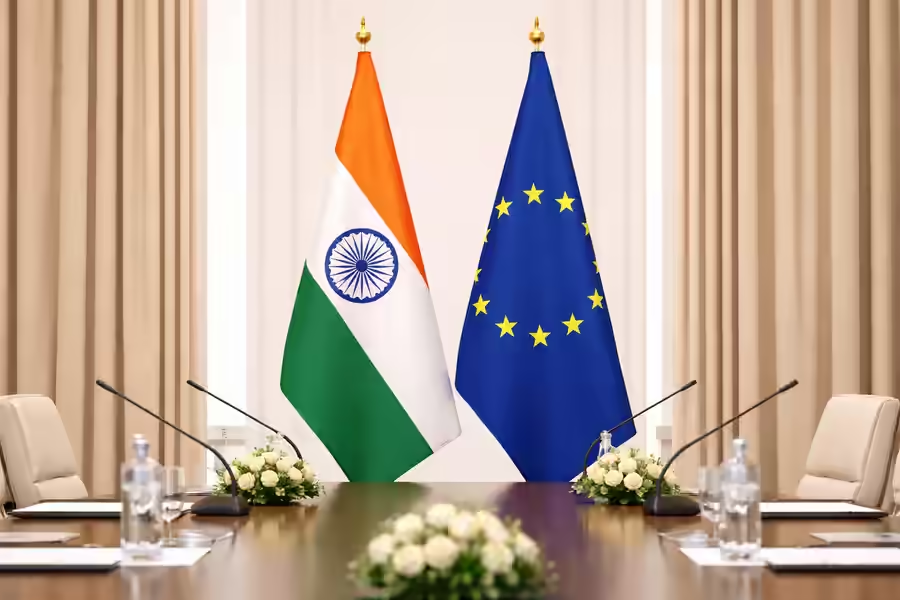
Less than 72 hours before European leaders travel to India for the 16th EU-India Summit, India and the EU are still working out the specifics of a trade deal.
The “Free Trade” Agreement (FTA), which has been in the works for more than 20 years and is proving challenging to negotiate due to “sensitivities” around agriculture, carbon border taxes, service delivery, and non-tariff obstacles, is the focus of the summit, which is set for January 27.
The EU College of Commissioners, headed by President Ursula von der Leyen, made its first visit to a bilateral partner outside of Europe in February 2025, demonstrating the strengthening of high-level India-EU relations in recent years.
Additionally, leaders kept in regular communication through phone conversations, such as those between the Prime Minister, President von der Leyen, and President Antonio Costa in September 2025, and met on the fringes of international gatherings like the G7 and G20, most recently in June 2025 in Canada.
A rules-based international order, democracy, the rule of law, and a dedication to successful multilateralism are among the common values and concepts that underpin India’s relationship with the European Union. Trade and investment, security and defense, renewable energy and climate action, digital transition, connectivity, research and technology, and people-to-people interactions are only a few examples of the wide range of ties.
With bilateral commerce amounting to almost $136 billion in 2024–2025, the EU continues to be India’s biggest trading partner for goods. In terms of both commodities and services, the EU is one of India’s main trading partners.
Over the course of several decades, the relationship between India and the EU has grown from simple diplomatic exchanges to a complex strategic alliance that addresses global issues like technology and climate change as well as political discourse, economic cooperation, and security.
From their first acknowledgement in the 1960s to the creation of yearly summits and collaborative projects in the 21st century, the relationships have advanced dramatically, demonstrating shared interests in investment, commerce, and sustainable development.
With the adoption of the “India – EU Strategic Partnership: A Roadmap to 2025” in July 2020, the resumption of free trade and investment negotiations in May 2021, and the establishment of the India-EU Trade and Technology Council (TTC) in April 2022, developments have accelerated compared to the early 2000s milestones that established the framework.
Building on this, the TTC’s second ministerial summit in February 2025 in New Delhi promoted collaboration in digital and green technologies, signifying a change from foundational discussions to practical, technology-driven collaborations.
Over the past ten years, India-EU relations have grown considerably, moving from mainly dialogue-based exchanges to practical, strategic partnerships in the areas of military, infrastructure, investments, labor mobility, and new global objectives.
This evolution has been guided by the ‘India – EU Strategic Partnership: A Roadmap to 2025’, which has culminated in high-level commitments like the proposed Security and Defence Partnership and the Trade and Technology Council (TTC), positioning India as a key partner in addressing common issues like supply chain security, climate change, and regional peace.
Based on similar ideals, expanding economic links, and shared strategic objectives, India-EU relations have developed into a solid and forward-thinking alliance. Growing trade, consistent EU investments, and collaboration in fields like digital technology, connectivity, clean energy, security, and labor mobility demonstrate a partnership that is yielding definite and useful results.
Also Read: Tata Punch Facelift Launched in India 2026 With Updated Design and Features
Deepening institutional alignment between India and the EU is shown in initiatives like the Trade and Technology Council, the Global Gateway, IMEC, and the advancement of FTA discussions.
Building on this momentum, India’s invitation to H.E. Mr. António Luís Santos da Costa, President of the European Council, and H.E. Ms. Ursula von der Leyen, President of the European Commission, for a State Visit on January 25–27, 2026, highlights the government’s intention to elevate India-EU relations as a fundamental pillar of its European and global strategy.