

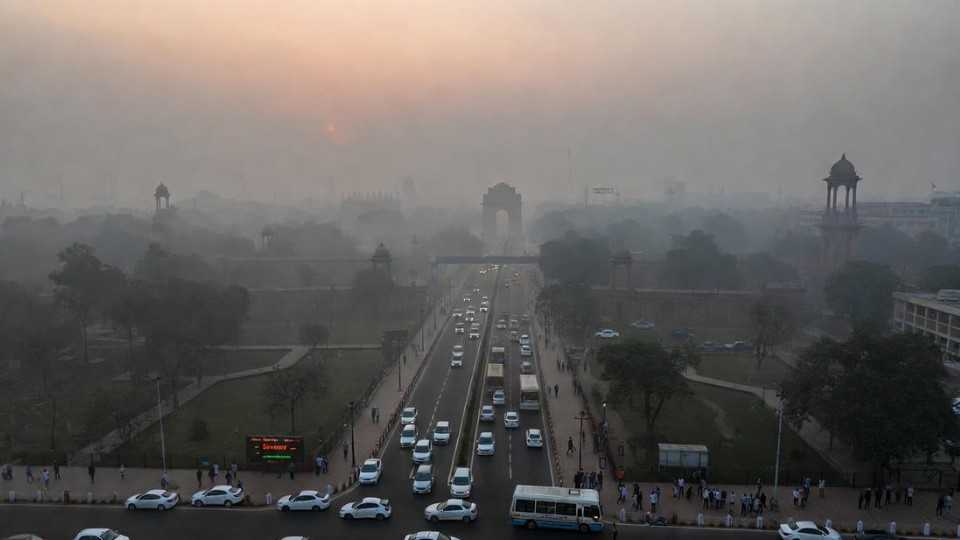
On November 11, the situation dramatically changed as the 24 hour average Air Quality Index (AQI) in the city reached a level of 400 and even crossed the so called ‘Severe’ category, which was previously not observed this year.
The AQI index of the city was estimated to be about 428 by the statistics provided by the Central Pollution Control Board (CPCB). The spike induced the authorities to deploy the Graded Response Action Plan level III (GRAP) in the city of Delhi and the areas of NCR in an effort to suppress the worsening situation.
The sharp rise is blamed on the hostile meteorological conditions, that is, still wind, low temperatures and a temperature inversion layer, which could not allow the dispersion of pollutants such that smog accumulated over the area.
What the Severity AQI is and what the GRAP 3 involves
When getting to the Severe level (401-450), AQI signifies that healthy individuals will also feel the adverse impact on their health with serious levels, and sensitive populations will be at a significantly greater threat. GRAP Stage III, in turn, suggests a set of emergency actions to reduce the level of pollution:
- Prohibition of non-essential construction and demolition activities in Delhi NCR.
- Older vehicle restriction BS-III and BS-IV four wheelers: all petrol and diesel versions of old vehicles are not allowed to ply, with the exception of persons with disabilities.
- Remote working policies by companies and remote or distance school (at least to Class 5) as an alternative to physical classes in order to minimise outdoor contact.
- Sealing up of stone crushers, mining and hot-mix plants that do not meet the clean fuel standards. There is also the hindrance of transportation of construction material by heavy trucks.
The aim of these measures is to reduce dust and motor vehicles as well as large-scale sources of pollutants on the fateful days when weather stagnates toxins along the surface.
What and Why This Happened and What to Watch
Analysts single out various converging factors:
- The drawing of pollutants upwards is blocked because of low temperatures during winter and the establishment of a warm air layer over cool surface air (inversion).
- Published slow wind speeds decrease the pollution of the aerosol and lead to the accumulation of PM2.5 and PM10.
- Contributions in the region the region is affected by emissions of stubble burning in other states, emissions through industrial elements, local vehicles and construction dust. Interstate cooperation is questioned.
In the next days, the inhabitants of the area can expect lingering haze, low visibility and increased health hazards. The weather forecasts indicate that winds may increase later, and this may clear the air, but at any change of condition, a further course of action may follow.
The Way Citizens Can Defend Themselves
At this air quality, it is necessary to take precautions:
- Restrict outdoor exposure, particularly in the case of children, aged people, and those with respiratory and heart abnormalities.
- Wear N95 (or other similar) masks in case you have to go out in heavy smog.
- Close windows and employ the use of air purifiers or indoor air filters.
- Do not burn wood, litter or other articles at home.
- Look up local air quality and take government advice.
Concisely, the first day to be recorded under the Severe air quality index in Delhi 2025 has already been documented, which has taken place with an immediate response under GRAP Stage III.
There is a lot at risk this is no haze, but it is an emergency of national health and the environment. City officials and residents must also be on their guard since this is the most susceptible season for polluting the city.