
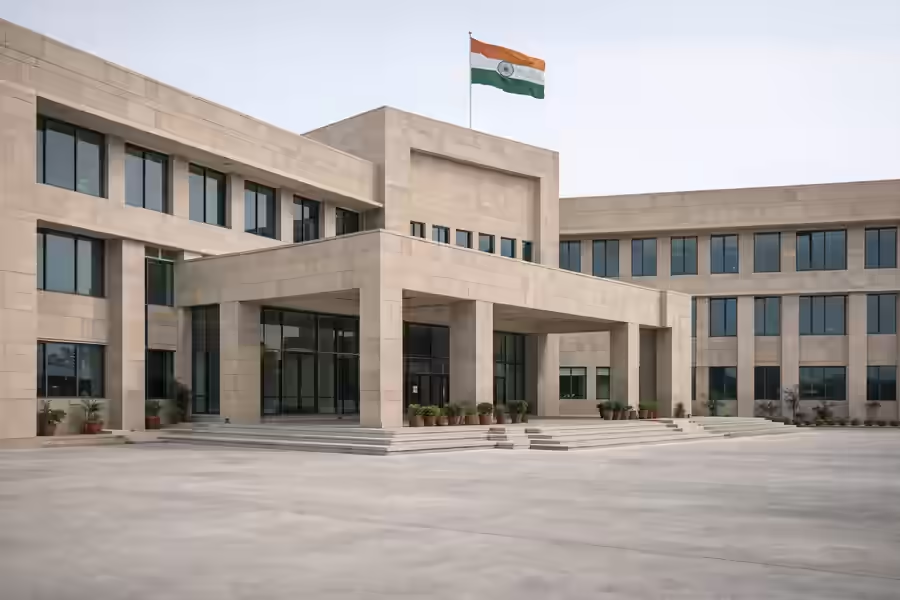
Today, Prime Minister Narendra Modi opened Seva Teerth, the new integrated complex that will house the Prime Minister’s Office (PMO), changing India’s most important speech. The first move since Independence signifies a move to a cutting-edge, contemporary building intended to improve administrative effectiveness and combine important executive responsibilities.
According to the government, the occasion is a transformative milestone in India’s administrative governance architecture, and the Prime Minister also unveiled a commemorative coin worth Rs 100 to celebrate the occasion.
Before formally launching Seva Teerth and Kartavya Bhavan 1 and 2, which will house various important ministries, he announced the name “Seva Teerth” at roughly 2:00 pm. According to officials, the project embodies the Prime Minister’s goal of creating a contemporary, effective, and citizen centered governance ecosystem.
PM’S FIRST DECISIONS FROM SEVA TEERTH
PM Narendra Modi authorized important programs that assist farmers, women, youth, and vulnerable communities in his first set of decisions after relocating to Seva Teerth. They include:
- PM Rahat scheme: Provides cashless treatment up to Rs 1.5 lakh for accident victims.
- Lakhpati didis target doubled: Goal was raised to 6 crore by March 2029, after crossing 3 crore ahead of schedule.
- Agriculture infrastructure fund: Outlay doubled from Rs 1 lakh crore to Rs 2 lakh crore to strengthen the farm value chain.
- Startup India fund of funds 2.0: Rs 10,000 crore corpus to boost deep tech, early-stage ventures and advanced manufacturing.
WHY MOVE TO SEVA TEERTH IS SIGNIFICANT
Ministries have been operating out of dilapidated, dispersed facilities throughout the Central Vista for decades, which has resulted in poor coordination, logistical challenges, and expensive maintenance. By uniting important administrative branches in infrastructure that is equipped for the future and built for smooth coordination, the new complexes seek to address these problems.
The government anticipates that the consolidation will increase transparency, lower expenses, and expedite decision-making.
KEY OFFICES UNDER ONE ROOF
Three key executive organizations that previously operated from different sites will be housed in Seva Teerth: the Cabinet Secretariat (Seva Teerth-3), the National Security Council Secretariat (Seva Teerth-2), and the Prime Minister’s Office (Seva Teerth-1). It is anticipated that their proximity will improve strategic coordination at the highest governmental levels.
Finance, Defense, Health and Family Welfare, Corporate Affairs, Education, Culture, Law and Justice, Information and Broadcasting, Agriculture and Farmers Welfare, Chemicals and Fertilizers, and Tribal Affairs are among the important ministries that will be housed in Kartavya Bhavan-1 and 2. The goal of the consolidation is to facilitate public access and enhance interministerial coordination.
DIGITAL INTEGRATION, CITIZEN-CENTRIC
To increase productivity and public involvement, the new complexes have centralized welcome areas, organized public interaction zones, and digitally integrated workplaces. Transparent administration and e-governance are anticipated to be supported by advanced digital infrastructure.
The complexes, which were constructed in accordance with 4-Star GRIHA standards, feature energy-efficient building design, waste management strategies, water conservation measures, and renewable energy systems.
The PMO claims that these actions enhance operational effectiveness while lessening their negative effects on the environment.
ENHANCED SECURITY
To maintain security without sacrificing usability, the buildings are outfitted with sophisticated emergency response systems, integrated surveillance, and intelligent access controls.
By combining important institutions into a contemporary, integrated complex that supports quicker, more coordinated, and citizen focused governance, the government hopes to establish a new standard for administrative infrastructure.
WHAT HAPPENS TO CURRENT PMO
After the Prime Minister’s Office has been moved out, the South and North Blocks will be transformed into the “Yuge Yugeen Bharat Sangrahalaya,” a public museum.
Also Read: Why Sonam Pandit Devotional Shivratri Reel Is Trending on Social Media
On December 19, 2024, a technical collaboration agreement for the projected museum’s creation was signed with France’s Museum creation Agency.