

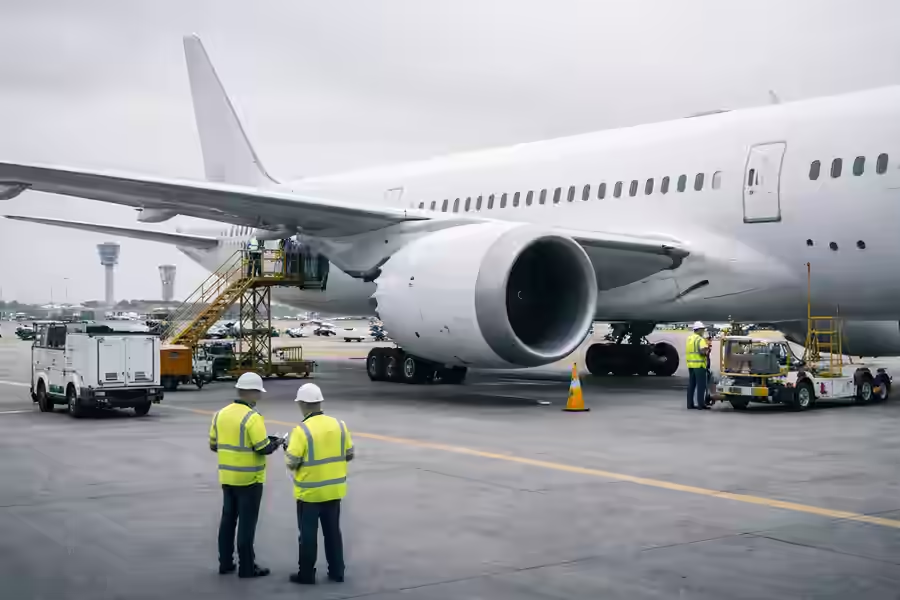
Following a pilot’s warning of a potential fuel control switch malfunction, Air India announced on Monday that it has grounded a Boeing 787-8 aircraft on a journey from London to Bengaluru. According to the airline, Boeing was notified of the problem, and the original equipment manufacturer of the aircraft is being contacted to investigate the matter as soon as possible.
The Directorate General of Civil Aviation (DGCA), the aviation regulator, has been informed of the situation, according to a statement from Air India. It further stated that all of the Boeing 787 airplanes in its fleet had their fuel control switches inspected in accordance with a DGCA mandate, and no problems were discovered.
The mid-air panic reminds me of the Boeing 787 Dreamliner that crashed into the BJ Medical College dorm building in Ahmedabad just seconds after takeoff last year while en route to London. The disaster claimed the lives of 260 individuals, including 19 people on the ground and 241 passengers and crew members on board.
The Aircraft Accident Investigation Bureau (AAIB) reports that both engines of the unfortunate aircraft briefly recovered from an initial loss of thrust, but they were unable to stabilize even after the switches were returned to “RUN.” In the end, 260 individuals were killed in the collision.
Later, the father of the late Captain Sumeet Sabharwal, the pilot-in-command of the Air India Boeing 787-8 Dreamliner that crashed in Ahmedabad in June and killed 260 people, Pushkar Sabharwal, filed a plea for an independent, technically sound investigation into the incident that was overseen by a retired Supreme Court judge.
UK incident challenges claim AI fuel switch movement was manual
In its initial investigation, India’s Aircraft Accident Investigation Bureau (AAIB) stated that the aircraft has not yet been determined to have any technical or design flaws, suggesting pilot activity.The fuel switch locking system was then required to be inspected by the DGCA.
Later, Air India declared that it had finished these inspections and discovered no issues. However, according to insiders, the London incident highlights the unanswered question regarding switch design, locking integrity, and the potential for unintentional activation.
“The London incident directly challenges the assumption that fuel switch movement in the Air India crash was manual,” stated a senior commander.The cut-off transition was regarded as almost definitive proof of pilot activity up until this point. The London incident demonstrates that uncontrolled switch behavior is a plausible failure mode due to mechanical detent failure, signal corruption, or other factors.
“The London incident is particularly concerning because in 2018 the US aviation regulator cautioned that fuel control switches on Boeing 787s could malfunction and lead to inadvertent engine shutdown,” stated air safety expert Capt. Amit Singh.
“We are aware that one of our pilots has reported a possible defect on the fuel control switch of a Boeing 787-8 aircraft,” Air India stated in a statement. We have grounded the aforementioned aircraft after obtaining this preliminary information, and we are working with the OEM to have the pilot’s concerns investigated as soon as possible.
Also Read: Nipah Virus and Bird Flu in India Assessing Human Fatality Risks
The DGCA, the aviation authority, has been informed of the situation. Following a mandate from the DGCA, Air India examined the fuel control switches on every Boeing 787 aircraft in its fleet and discovered no problems. “We are in contact with Air India and are supporting their review of this matter,” stated Boeing.