
This year’s budget, like all Union Budgets, offers a combination of benefits and drawbacks for various economic sectors. On Sunday, Finance Minister Nirmala Sitharaman unveiled a budget designed to strike a balance between reform, stability, and growth.
Congress spearheaded the opposition’s criticism of the Union Budget, claiming that it lacked a plan to deal with the country’s growth and unemployment problems and that the economy was in terrible shape.
While the budget offers numerous compliance friendly measures and targeted tax changes, it also tightens the screws in specific sectors to shore up revenues. Instead of announcing large rate reductions, the government has concentrated on streamlining procedures for taxpayers. Stress reduction and increased trust are the goals of initiatives like decriminalizing some crimes, and extending the time to amend income tax returns.
Leader of opposition of Lok Sabha Rahul Gandhi said, ”Youth without jobs. Falling manufacturing. Capital is being removed by investors. Savings in households are falling. Distressed farmers. Looming global shocks all disregarded. A budget that ignores India’s actual problems and refuses to change course”.
Mallikarjun Kharge, the head of the Congress, claimed that the Modi government had run out of money. Inequality has increased to levels seen during the British Raj, yet the budget makes no mention of it or offers any assistance to SC, ST, OBC, EWS, and minority populations.
According to former FM P Chidambaram, Nirmala Sitharaman failed to address any of the issues raised by the Economic Survey, such as the US tariffs’ stress on exporters and its effect on investment, the precarious employment situation, particularly youth unemployment, the trade deficit, the private sector’s reluctance to invest, low FDI and FII outflow, the discrepancy between inflation figures and actual conditions, and the widespread closure of MSMEs.
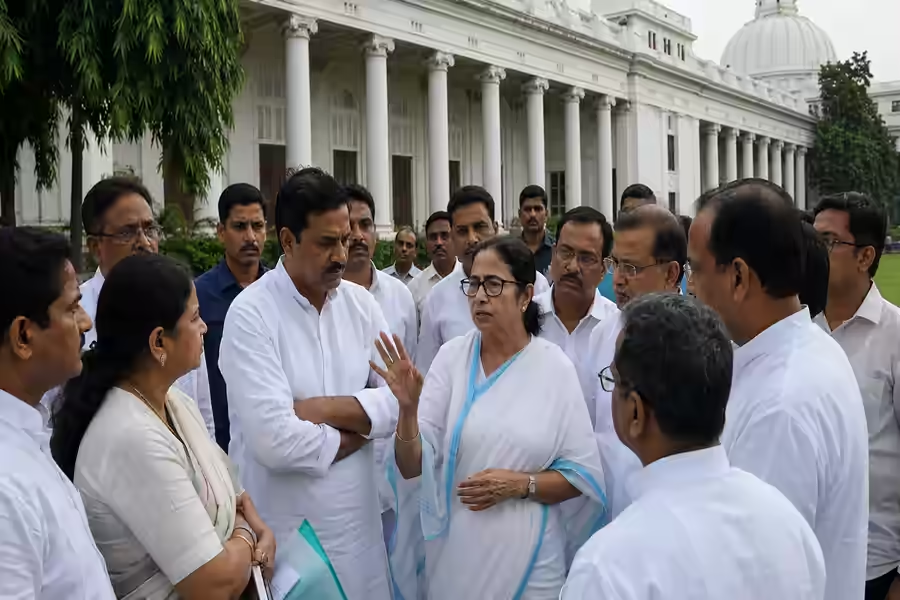
Akhilesh Yadav, the leader of the SP, ridiculed the budget, calling it a gift for the richest 5% of people and lacking in ideas to assist the underprivileged and give young people work. “It’s a Humpty Dumpty Budget where the speech’s “jugglery of words” and “sound and fury” cannot hide the fact that Bengal did not receive anything,” stated TMC chief Mamata Banerjee.
“Education funding and subsidies have decreased. Fertilizer and social security subsidies are decreasing. The economy has completely collapsed. She added, “The Budget is a garbage of lies and reflects incompetence. It is directionless, visionless, missionless, and actionless.”
CPI (M) said the Budget has again demonstrated that Modi govt is committed to a few big business houses and the wealthy, at the cost of the working people and vulnerable sectors.
Also Read: Momo For Rs 85 Lakh? UP Boy Gives Away Family Jewellery to Vendor
Bhagwant Mann, the chief minister of Punjab, claimed that the budget disregarded the state and did not provide jobs for young people or MSP for farmers.
Here are the major gains and pains from
For Taxpayers
Gains
- Finance minister Nirmala Sitharaman announced several relief measures for taxpayers The deadline to revise income tax returns can now be extended by three months
- To ease overseas spending, the government reduced the Tax Collected at source (TCS) rate under the Liberalised Remittance Scheme. TCS on foreign education, medical treatment and overseas tour packages has been cut to 2% from 5%.
- Small taxpayers will benefit from a rule based automated process for online issuance of lower or nil tax deduction certificates.
- The Minimum Alternate Tax (MAT) rate has been reduced to 14% from 15% and will now be treated as a final tax. The Budget also proposed decriminalisation and rationalisation of penalties under the income tax act.
Pains
- The finance minister clarified that no new MAT credit will accumulate from April 1, 2026, and existing credits can only be set off under the new tax regime.
- Tax exemption on disability pension has also been restricted to service personnel who were forced to retire early due to disability.
For Investors
Gains
- The Budget raises foreign portfolio investment limits in listen Indian equities, with the individual cap increased from 5% to 10% and the overall limit from 10% to 24%.
- To ease compliance, buyers of property from non residents will no longer need a TAN for tax deduction.
- The government has also revamped the taxation of share buybacks, with proceeds now to be taxed as capital gains for all shareholders, a move aimed at protecting minority investors and preventing tax arbitrage.
Pains
- To curb speculation, the government has raised STT on derivatives from April 1.
- No deduction on interest expenses for income from dividend or mutual funds.
- Capital gains exemption on sovereign gold bonds only for original subscriber who holds on till maturity.
For Consumers
Gains
- No basic customs duty on 17 life‑saving drugs , including for cancer, on drugs, medicines.
- Duty on some microwave parts cut.
Pains
- No duty sops on materials for e-reader, adult diapers, video games.
- 10% BCD on CD-ROMs of educational books, journals, mags, news.
For Business people
Gains
- It announced a series of measures for Customs and central excise aimed at simplifying the tariff structure, boosting domestic manufacturing, and improving export competitiveness and global trade tensions.
- Validity of customs advance ruling extended to 5 years
- Customs duty exemptions extended to various capital goods and parts.
- Measures to promote exports of marine, leather and textile products.
Pains
- Nil customs duty set to lapse on ATMs and its parts, TV equipment, cameras, other filmmaking equipment.