
Three days of national mourning for the victims of a high-speed train collision that claimed at least forty lives have been declared by Spanish Prime Minister Pedro Sanchez. While rescuers continue to explore the debris, Sanchez also pledged to investigate the cause of the collision between the two high-speed trains in southern Spain.
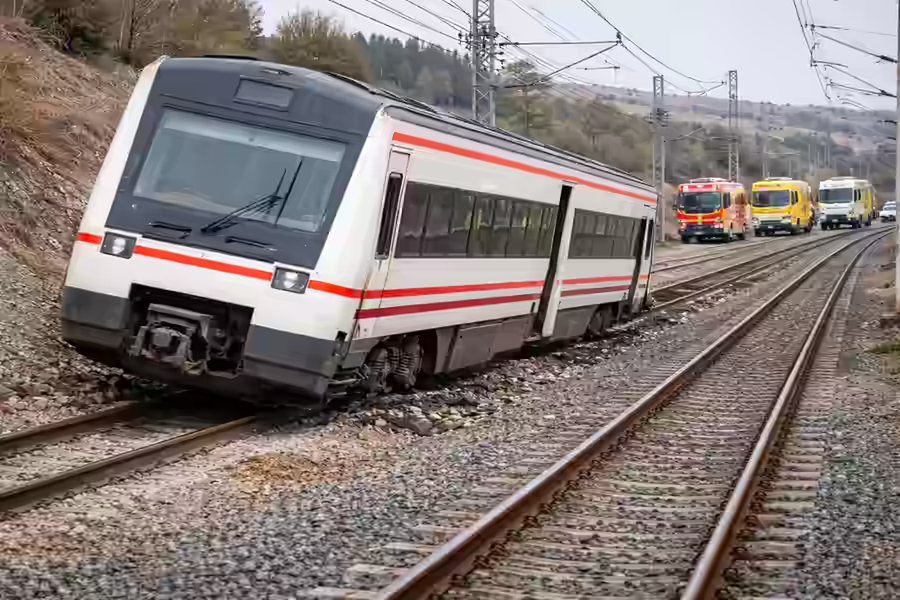
On Sunday night, carriages on a train headed for Madrid derailed, crossed over to the other tracks, and collided with an approaching train near Adamuz, injuring over 120 more people. It’s the worst crash the nation has experienced in over ten years.
According to rail network operator Adif, the incident occurred on Sunday at 19:45 local time (18:45 GMT), around an hour after one of the trains departed Málaga on its way north to Madrid. The train derailed on a straight section of track close to Córdoba.
Transport Minister Oscar Puente stated that the second train’s carriages were forced onto an embankment by the force of the collision. The majority of the dead and injured, he continued, were in the front cars of the second train, which was heading south from Madrid to Huelva.
Rescue crews reported that it was challenging to free those trapped inside the carriages due to the mangled train wreckage. On Monday afternoon, Sanchez went to the crash scene with high-ranking officials.
“We are going to get to the truth, we are going to find the answer, and when that answer about the origin and cause of this tragedy is known, as it could not be otherwise, with absolute transparency and absolute clarity, we will make it public.”
Puente called the occurrence “extremely strange” and stated that an inquiry could take at least a month.
However, an unidentified person briefed on preliminary investigations told the Reuters news agency that experts had discovered a defective rail joint that was causing a gap between rail sections to expand as trains passed over it. The joint was crucial in determining the accident’s cause, they continued.
It was unclear whether the problem was a cause or an effect of the disaster, according to Spain’s El Río newspaper. The two trains carried 400 passengers and employees, according to the rail authority. Of the 122 individuals treated by emergency services, 41 including children remain hospitalized. Twelve of them are in critical condition.
According to Puente, the death toll “is not yet final”. Authorities are attempting to identify the deceased. A representative for the Italian rail operator Ferrovie dello Stato told Reuters that the train involved in the collision was a Freccia 1000, which has a top speed of 400 km/h (250 mph).
A Madrid-bound passenger, José, told public broadcaster Canal Sur: “There were people and screaming, calling for doctors.” All high-speed services between Madrid and the southern cities of Malaga, Cordoba, Sevilla and Huelva have been suspended until Friday.
Both King Felipe VI and Queen Letizia expressed their “most heartfelt condolences” and said they were “with great concern” after learning of the tragedy. Any crash survivors were advised by the Andalusian emergency agency to get in touch with their loved ones or announce their survival on social media.
In addition to providing counseling to local families, the Spanish Red Cross has sent emergency support services to the area.
“The families are going through a situation of great anxiety due to the lack of information,” Miguel Ángel Rodríguez of the Red Cross said on RNE radio. These are really upsetting times.
Spain’s worst high-speed train derailment occurred in Galicia, northwest Spain, in 2013, resulting in 140 injuries and 80 fatalities.
Also Read: L’Oréal to Set Up Global Tech Hub in Hyderabad With ₹3,500 Crore Investment
With more than 50 cities connected, Spain has the second-largest high-speed rail network in the world, after China. The Spanish rail system is more than 4,000 kilometers (2,485 miles) long, according to Adif data.