

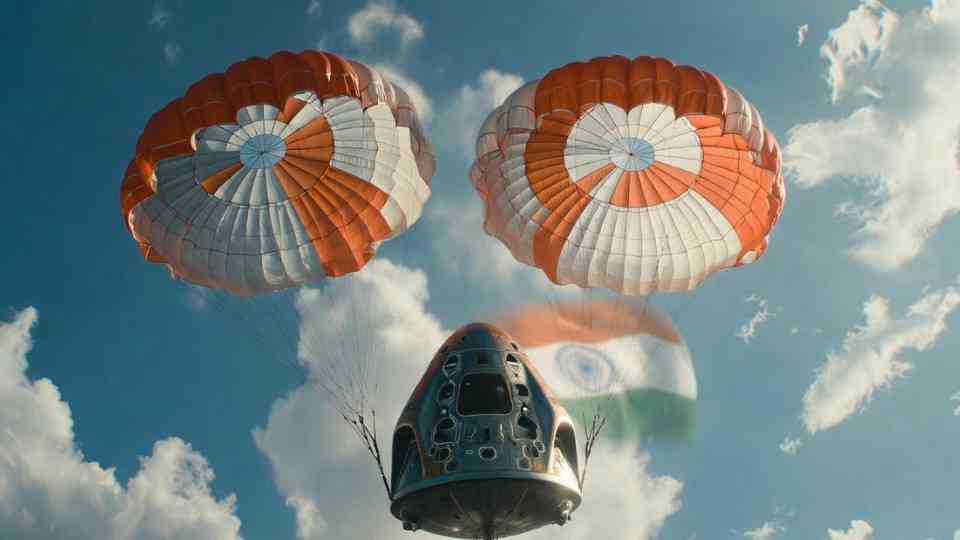
The Indian Space Research Organisation (ISRO) publicized that the organization has completed a critical parachute drop examination on the Gaganyaan crew module. The test, on November 3, 2025, in the Babina Field Firing Range in Jhansi, Uttar Pradesh, was a simulated version of one of the most difficult landing scenarios that the module in question could encounter, i.e., a lag in the deployment of one of the primary parachutes.
The Gaganyaan crew module has a specially designed parachute system, which consists of ten parachutes of four kinds. Two apex cover separation parachutes that eliminate the protective cover of the parachute compartment then initiate the deployment.
Two drogue parachutes are then added to stabilize and slow down the module, and then three pilot parachutes subsequently launch three main parachutes. The engineered system is also drawn with redundancy only two of the three major parachutes are required in the system to continue with safety.
Test Details & Significance
This test had the ISRO carry out a mass simulator of the crew module and then drop it at an altitude of 2.5 km by an Indian Air Force IL-76 aircraft. To prove the integrity of the structure in off-nominal conditions, they developed an intentional scenario of asymmetric debriefing (debriefing another of its main parachutes) to confirm it.
This led to the perfect sequence: the parachutes came out in the correct sequence, the falling was not turbulent, and the simulated module made a soft landing. This check is essential since the last landing and descent is one of the most dangerous stages of the human spaceflight program. The success of this makes ISRO another milestone towards the Gaganyaan program that hopes to place Indian astronauts in orbit by 2027.
Situation in the Gaganyaan Mission
The Gaganyaan mission is the first crew orbital program in India that was scheduled to launch Indian astronauts into low Earth orbit.
Although several subsystems, such as escape engines and life support systems, among others, are being designed, a parachute based deceleration system is very crucial in assuring a safe return to Earth. Earlier versions of the parachute stack were tested earlier and confirmed by the previous tests, like the August 24 IADT-01 air drop.
This demonstration of the strength of the landing system through its ability to simulate one of the most difficult parachute failure modes enables the ISRO to reveal the maturity of the landing system and the road towards mission readiness. This effort has been well supported by the agencies of DRDO, including its ADRDE (Aerial Delivery Research and Development Establishment), IAF, Indian Navy, and Indian Coast Guard.
What’s Next & What to Watch
Having the main parachute system now qualified in this scenario, ISRO would still need to undertake other qualification tests under loading variations, altitude, and descent angle variations. The next steps include:
- Further integrated main parachute airdrop tests under other circumstances.
- Certification of heat shield and splashdown/recovery scenarios of the crew module.
- Final applications of the system that arrive at a few test flights with uncrewed (TV-D1) or similar before crew join-up.
According to mission observers, the human-spaceflight window (first crewed launch) has been provisionally scheduled to occur in 2027, provided that all tests run up to now do not cause any significant delay.
Since India is nearing the league of nations that can independently carry out human spaceflight, such systems as the parachute deceleration stack are of mission-critical requirements. The successful test affirms:
- Safety priority: It is important to be able to descend and land astronauts safely in extreme conditions.
- Technical maturity: Sophisticated engineering is shown by the sophisticated arrangement of types of parachutes and pyro devices.
- National deliverable: Firms up India’s space technology expertise internationally.
To conclude, the parachute test of the Gaganyaan crew module by ISRO is a big milestone forhuman spaceflight in India. Critical systems have been confirmed, and therefore the mission is now one step closer to becoming reality and India is in preparation to launch its astronauts into space.