

Even a decade ago, a majority of transactions in India were still cash-based and online payments were a preserve of a few individuals. Now that world is a whole lot different. The Unified Payments Interface (UPI) is at the heart of this transformation, as it has transformed the way money flows in and out of the country and enabled payments to be instant, easy, and accessible to millions of people.
The increase of UPI has not only been concerning convenience. It has fundamentally changed how people, enterprises and even governments engage with the financial system and is moving India into a more inclusive and digital economy.
The base of a digital transformation
The evolution of India towards digital payments did not happen overnight. Early systems like RTGS and IMPS formed the foundation by offering quicker bank transfers, however, their usage was restricted and in most cases demanded greater technical knowledge.
An even greater surge was associated with the extension of access to banking and digital identity. With the implementation of bank accounts through financial inclusion programmes, along with Aadhaar-based identification and mass mobile connectivity, the foundation was laid on which mass digital uptake could be achieved. This ecosystem made formal banking services accessible to more people and enabled them to engage in digital transactions.
UPI, introduced by the National Payments Corporation of India in 2016, was based on this and made it even simpler. Rather than filling in lengthy bank details, users were in a position to send or receive money through a simple virtual payment address. This change eliminated a significant hurdle to digital transactions and simplified transactions among common users.
Blistering development and gigantic size
Use of UPI has been among the most rapid in any financial system in the world. What began as a comparably small network has developed into a gigantic infrastructure linking hundreds of banks and millions of users.
At the beginning of 2026, the list of banks on the UPI network had increased greatly, establishing a consistent system in which transactions could occur without issue across platforms. This growth is indicated by the size of usage. Just in a month, January 2026, the system handled more than 21 billion transactions with a value amounting to tens of lakh crore rupees.
UPI now represents a leading portion of the retail digital transactions in India and is also the largest real-time payment system in the world by volume. This is a quick increase in less than ten years which points to the speed of change in the digital behaviour in the country.
Driving inclusion and everyday usage
Among the greatest effects of UPI is the contribution it has made to the financial inclusion. It has introduced small merchants, street vendors and rural users into the digital economy by decreasing reliance on cash and decreasing the transaction costs.
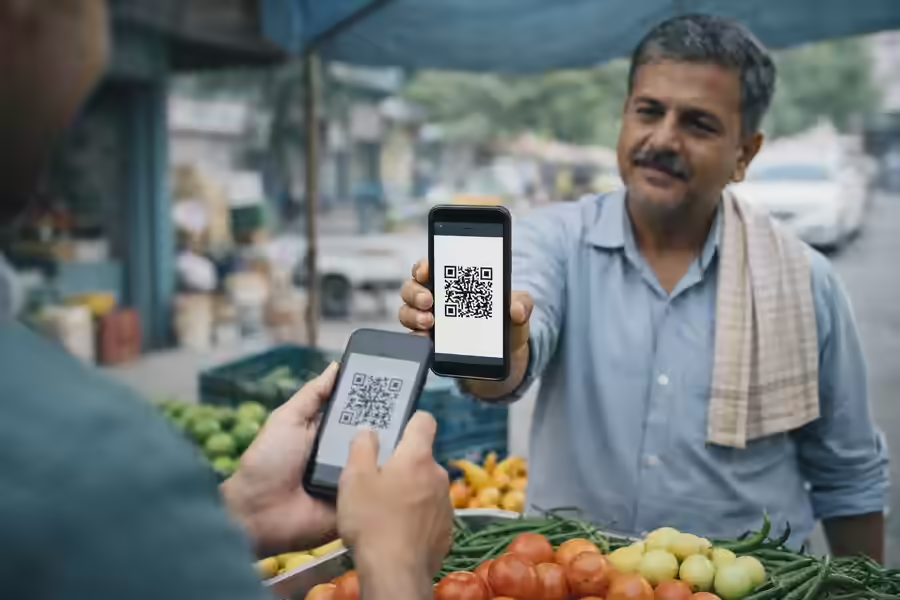
The convenience has promoted the use of digital payments even among first time users. The presence of a plain QR code on a shop or a little roadside stand is now sufficient to execute a transaction, which would have been considered improbable few years ago.
Also Read: Deepika breaks silence on Dhurandhar 2, gives sharp reply to trolls
The ecosystem has also advanced over the years acquiring other features. Additional services like small-value payment service, automated recurring payments and credit-linked transactions have increased the application of UPI beyond simple transfers. On this infrastructure, financial institutions and fintech platforms have added new services, further enhancing the ecosystem.
Security and regulatory assistance
With the rise of digital payments, the need to guarantee security emerged. The structure of UPI enables consumers to make transactions without exposing any sensitive banking information which minimizes the chances of data leakage.
Also Read: Asim Munir’s uniform diplomacy: Combat gear for Iran, suit for US
The regulators have also intervened to make the system stronger. Other measures introduced by the Reserve Bank of India to provide more safeguards in digital transactions are the mandatory use of multi-layers in authentication. These are intended to help curb fraud and establish more trust among the users, particularly with the volume of transactions that are ever growing.
Security has played a paramount role in ensuring confidence in the system, especially to new users who are in the process of replacing cash with digital payments.
International fame and growth
The UPI-led digital payments model has attracted international attention in India. It has been identified by international organisations as a model of creating scaled and inclusive financial systems. The capability to process billions of transactions monthly without being expensive has distinguished it among numerous other payment structures all over the globe.
Also Read: From critic to negotiator: JD Vance leads crucial Iran peace mission
UPI has also started going outside of India. It has already been launched or connected to payment systems in a number of countries, allowing cross-border transactions and facilitating the transfer of funds between countries easier. This growth is an indication of increased trust in the site and how it can shape the payment systems in the world.
The move toward cash-intensive operation to that of a QR culture of payment has been swift and transformational. UPI has made the payments easy, but also altered habits, moving millions into the formal financial system. This is probably to keep it at the centre of the digital economy of India in the years to come as adoption keeps on rising with the addition of new functionalities.