
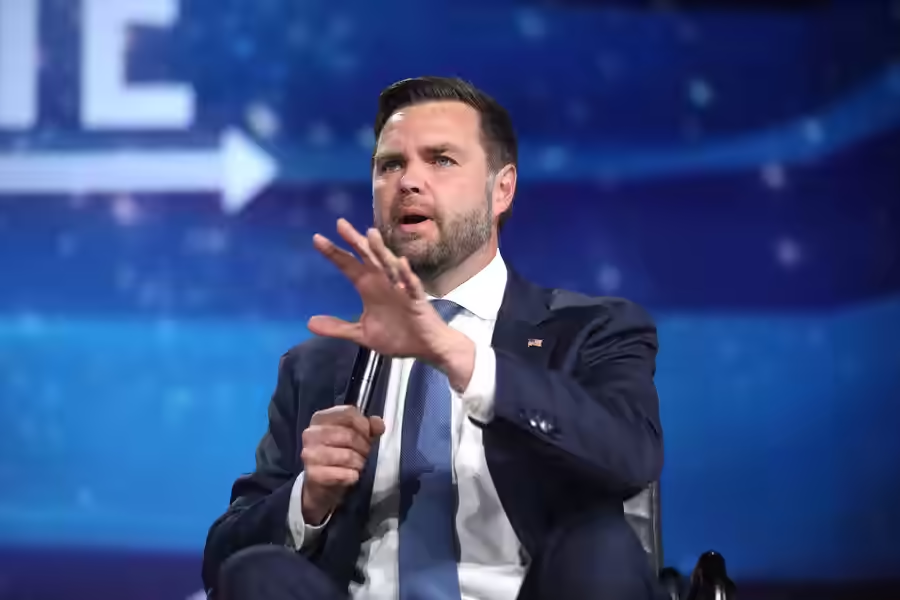
A high-stakes peace negotiation with Iran has brought US Vice President JD Vance into a very defining diplomatic position at a time when tensions in West Asia are still at stake with a temporary ceasefire. The appointment is a drastic change to Vance who had previously aligned himself as a moderate opponent of increased American involvement in external wars.
The negotiations, which are held in Islamabad, are closely monitored in the world capitals. As both parties are forced to keep the situation as low-profile as possible, the results might not only affect the relations of the US and Iran but also the stability of the region as a whole.
Scepticism to centre stage
It has not taken long before Vance has risen to the front of this diplomatic effort. He had up to now stood in apparent contrast to military-intensive foreign policy choices, frequently pointing out the dangers of long-term commitments abroad. His stand in the public was indicative of the worries of the subdivisions of the American political arena that are still apprehensive of new conflicts.
The changing scenario, however, seems to have changed his position considerably. Vance, a move that is perceived as an effort to give the process political power and presence, is believed to have been assigned that responsibility personally by Donald Trump. The dispatch of the vice president is an indication that Washington is taking the talks seriously, according to the officials.
When he was requested to lead the mission, Vance was said to be in Budapest, where he was reported to have been conducting political outreach with Hungarian Prime Minister Viktor Orbán. His new position put him squarely in a conflict which he had already attempted to evade, and which he was now a part of, as unexpected and weighty.
A sensitive and strenuous negotiation
The talks in Islamabad are being termed as one of the most significant interactions between the United States and Iran in decades. Although diplomatic links have been established as over the years, the current negotiations are timed at a very sensitive time as the recent hostilities remain still fresh and levels of good faith are low.
Also Read: Asim Munir’s uniform diplomacy: Combat gear for Iran, suit for US
There are several topics at stake, such as nuclear policy, the lifting of sanctions, and the concerns related to the security of the region on the whole. These issues are complex and therefore development would be slow and controversial, and both parties will be adamant about their major demands.
The conflict is also affecting dialogue, as regional actors are contributing to it. The presence of mediators highlights the fact that the situation is highly interconnected, and neighbouring countries are interested in avoiding further instability.
Domestic forces and political uncertainties
At home, the talks are going on in the backdrop of political split in the United States. Even certain segments of the political spectrum, such as some of the supporters of Trump himself, are vociferously against any action that would involve the nation further in foreign conflicts.
Also Read: Deepika breaks silence on Dhurandhar 2, gives sharp reply to trolls
This is a balancing act to Vance. He has to balance expectations on the global level and at the same time handle domestic issues on where the US foreign policy is headed. His previous opposition to intervention contrasts with his current active diplomatic role, in which he is actually defending and spearheading a significant diplomatic effort.
According to the sources, the vice president does not lack information on the stakes involved. The successful result would help him gain more credibility as a negotiator on the international arena. Meanwhile, a loss or a lengthy stalemate would bind his political prospects to a war that most Americans would wish to avoid.
A test with potential to define future diplomacy
The ongoing stage of negotiations is done in the backdrop of a weak ceasefire that is under strain. A single failure might easily lead the situation back to the brink of escalation and thus the negotiations currently taking place are all the more important.
In the case of Vance it is not only a matter of coming to an agreement but also a matter of controlling perceptions both on the international front and domestically. His shift to being a critic of intervention to a key participant in peace processes shows how fast political roles can change in times of global crisis.
With the talks going on in Islamabad, the focus will always be on whether the diplomatic push will bear any fruit. The result will not just define the future of the US-Iran relations in the short-term, but can also determine the way Washington will handle such conflicts in the future.