

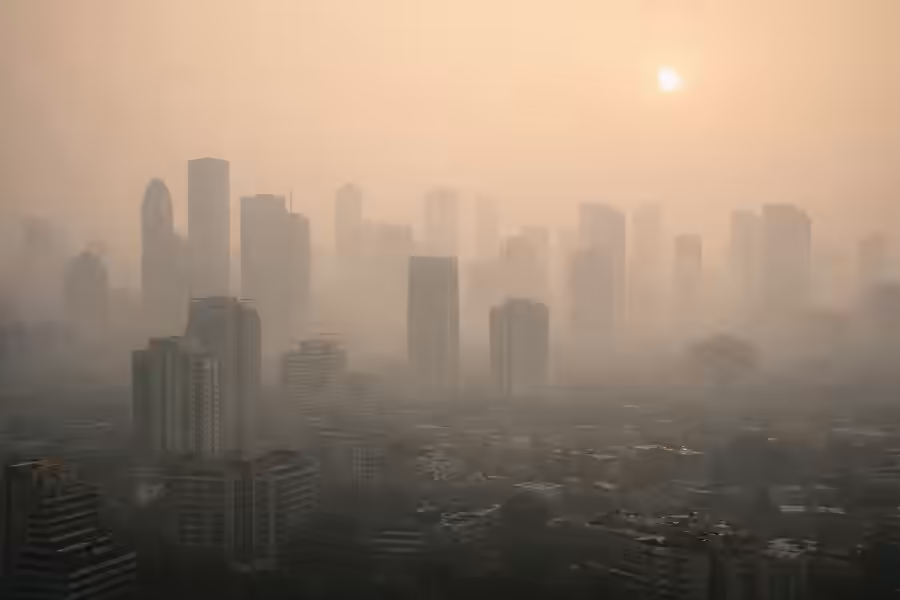
In three years, February has been the warmest and most polluted in Delhi. At 31.9 degrees Celsius on Friday, the temperature was six degrees higher than usual. The lack of significant western disturbances this month is probably the cause of the unusually warm national capital.
At 27 degrees Celsius (°C), the average maximum temperature in February was 2.8 degrees warmer than the long period average (LPA) of 24.2°C. This temperature is regarded as the highest from the average maximum since February 2023, when it reached 28.2°C.
Effect of weak western disturbances
Experts connected a significant lack of rainfall to the recent spike in warmth and pollution. Delhi has only received 0.5 mm of rain this month, significantly less than the typical 21.3 mm, according to data from the India Meteorological Department (IMD).
There has been little to no rainfall in the plains and little snowfall in the mountains due to weak western disturbances across the Himalayan region.
In Delhi, we only had sporadic, patchy drizzle a few days. Even if the maximum dropped momentarily because of cloudy skies, there was no appreciable cooling, said Mahesh Palawat, vice-president of Skymet, who also noted that Delhi’s pollution levels rise as a result of the absence of rains. Pollutants settle as a result of the washout effect when there is a significant period of rain. This was not observed in February, he continued.
A similar pattern was seen in February 2025, when there was only 1.4 mm of rainfall and an average maximum temperature of 26.7°C.
In contrast, 32.5 mm of rain fell in February 2024, maintaining a lower average high temperature of 24.4°C and contributing to comparatively better air quality. Delhi had no rainfall in 2023, and the average maximum temperature was 28.2°C, the highest level in 15 years.
In the evening, 22 monitoring stations reported moderate air quality, 14 recorded poor, and two highlighted very poor, according to the Central Pollution Control Board’s SAMEER app.
An AQI between zero and fifty is categorized as good, 51 to 100 as satisfactory, 101 to 200 as moderate, 201 to 300 as poor, 301 to 400 as very poor, and 401 to 500 as severe by the CPCB.
The Centre for Research on Energy and Clean Air (CREA) found that Delhi’s February air quality was the worst in three years, with an average AQI of 234 until February 26.
In February, the capital experienced 20 days with poor air quality, two days with very poor air quality, and four days with moderate air quality.
Also Read: Gold Silver Price Today Feb 28 2026 – Check city-wise Price in Mumbai, Delhi, Kolkata and more
According to data from the Central Pollution Control Board (CPCB), the city’s air quality was classified as moderate at 9 a.m. on Friday, with an Air Quality Index (AQI) value of 187.