
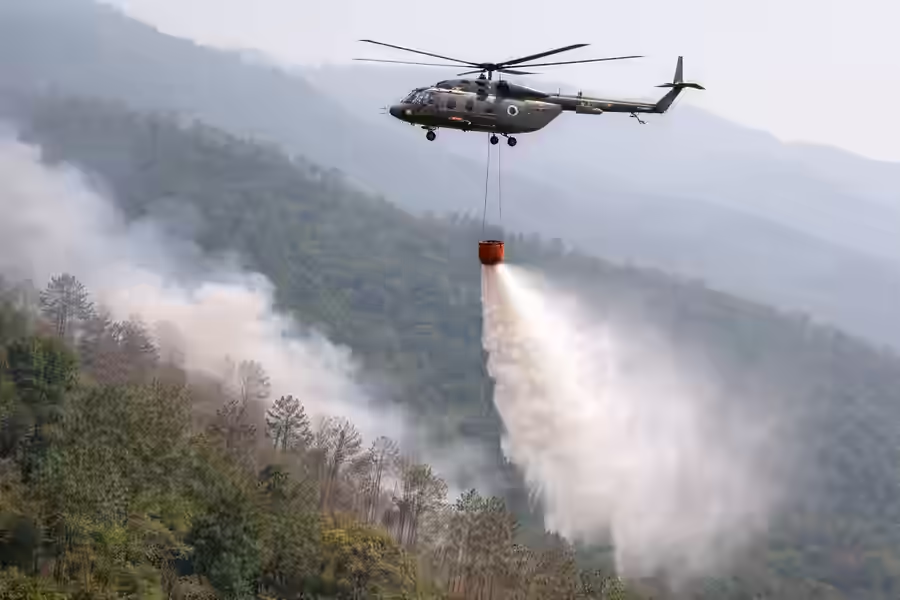
The Indian Air Force (IAF) undertook a major operation to fight forest fires in Lohit Valley in Arunachal Pradesh and deployed at least 12,000 litres of water in high-altitude conditions to curb the fire using Mi-17V5 helicopters, officials said on Thursday.
This mission entailed flying and working in an altitude of almost 9, 500 feet above the sea level where the Himalayan air was thin and that posed serious challenges in aerial firefighting. The IAF posted on X (previously Twitter) the hard work of the mission and commended the accuracy and boldness of its pilots.
Fighting forest fires almost at 9,500 feet in the Lohit Valley of Arunachal Pradesh. The exceptional courage and precision used by IAF Mi-17V5 helicopters to drop 12,000 litres of water in rarefied air of Himalayas, demonstrated their dedication to save lives and delicate ecosystems, the force wrote.
The forest fires in northeastern Himalayan area are a great threat not only to the wild life and plants at this area but also to the human settlement surrounding the area. The intervention by the IAF was in line with the organized efforts to prevent the fire and assist the civil authorities in the area.
Quick Response Force in Baramati
The Arunachal firefighting operation is a part of a set of quick response operations by the IAF. In another operation earlier this week, the force had sent a specialised team of Air Traffic Control (ATC) staff and essential technical gear of Air Force Station Lohegaon to Baramati Airport in Maharashtra.
It was done at a desperate bequest of the Maharashtra state government after unfortunate plane crash in the district killed the Deputy Chief Minister Ajit Pawar in the morning of January 29. The accident caused the temporary termination of normal work in the airports and this would require the immediate assistance to handle the air traffic safely.
The defence authorities claimed that the team was able to set up emergency ATC services within no time comprising of communications and other necessary installations in close consultation with the local authorities. This permitted safer and more effective control of air traffic in the process of continued recovery and investigation of the scene of the crash.
As a prompt response to a desperate appeal of the civil authority following the heartbreaking aircraft accident in Baramati Airport, the Indian Air Force has responded promptly by deploying a special team of Air Warriors.
They are also supplying the necessary basic Air Traffic Control and Meteorological services to facilitate safe air operations within the location. This quick response highlights how IAF takes national service during the hour of need, the IAF said in an X post.
Rapid Deployment of Troops by air
The forest fire in Arunachal Pradesh highlights the IAF’s increased participation in humanitarian and disaster management activities, in addition to its traditional defense operations. High-altitude operations also present special challenges, such as reduced lift and engine performance, which can make helicopter water-bomber operations difficult.
The ability to deliver thousands of litres of water to the fronts of a fire amid such terrain is an indication of high levels of skill and training of the pilots and support crews in the service.
According to officials, the Mi-17V5 fleet, which is among the workhorse helicopters in the IAF inventory was selected because of its strong performance and capabilities to perform activities even in unfavorable environments. The fact that the aircraft can transport and precisely drop mass volumes of water on moving fire lines makes the aircraft a worthy tool in the fight against extensive forest fires in built-in landscape.
Co-ordinated Operations with the Civil Auxiliaries
The two deployments, to Arunachal Pradesh and Baramati, are indicative of how the IAF was increasing its collaboration with civilian governments in case of emergencies. Lately, the force has been utilized in response to disasters of floodwaters and cyclones among others, providing a quick way to move around, aerial survey, and emergency support in logistics.
As it happened with regard to Baramati, the IAF mobilisation of trained ATC staff early on was used to fill a very important lapse in aviation infrastructure that was created after the crash. The team helped have safe airspace operations by restoring basic traffic management and weather reporting capabilities during investigations and recovery.
Response by the Public and Government
The deployments have attracted a lot of attention and appreciation by the officials and citizens. The civil officials in Arunachal Pradesh recognized the arrival of the opportunity to fight the forest fire and the political leaders in Maharashtra have praised the IAF participation in the Baramati tragedy after the accident.
The departure of the Deputy Chief Minister Ajit Pawar has been deeply felt in the state and the political circles of the whole nation and the manner in which the IAF reacted to this has been regarded as a stabilising factor in a time of crisis.
With the ongoing investigations on the Baramati crash, the role of air force in ensuring air safety and operational continuity has highlighted its preparedness and flexibility to various missions.
The two missions that the Indian Air Force undertook last week are indicative of the overall duty of the force to act not merely as a fortification of the Indian nation but as a humanitarian force in case of natural calamity to the populace.
The IAF remains an indispensable force in the country, whether they are fighting forest fires in the remote Himalayan valleys or rebuilding essential air traffic facilities after some unforeseen aviation accident.
Also Read: TikTok Influencer Alina Amir’s Viral MMS Deepfake Explained as She Breaks Her Silence
It was pointed out by officials that the two missions were the one that were conducted closely in consultation with local governments and civil aviation authorities to ensure that, in the process, strategic goals were achieved with minimal negative impacts on the local communities.
With the forest fire situation in the Lohit Valley getting under control and air traffic services restored to normalcy at the Baramati, all now shift their focus on continued relief and restoration operations with the IAF being at ready to help in any way necessary.