
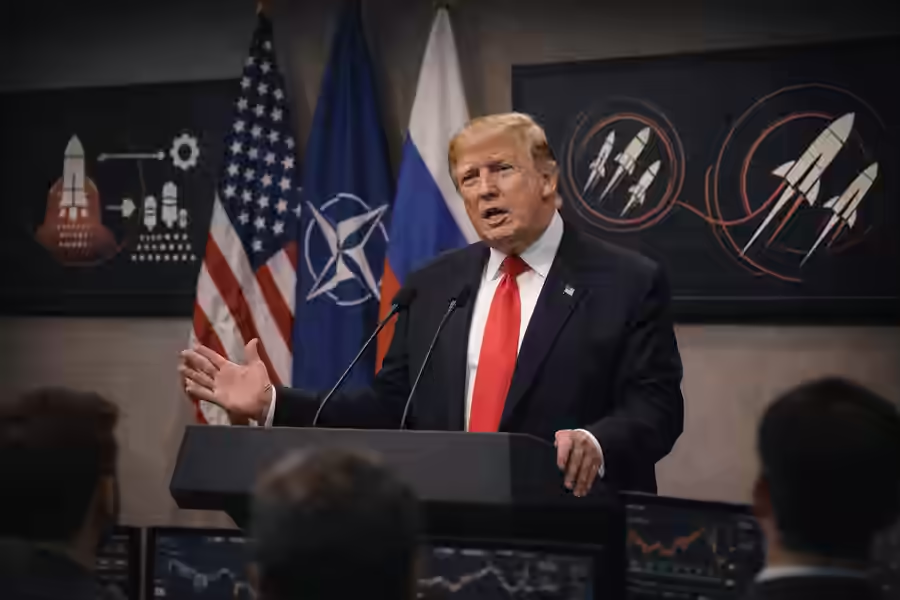
U.S. President Donald Trump has ordered a new and modern nuclear arms control treaty to replace the now-outdated New START agreement with Russia, saying the decades-old framework was defective and no longer useful.
His statements have escalated international fears regarding the possibility of an unregulated nuclear weapons arms race in the midst of an increased geopolitical tension.
In a speech where the New START treaty officially expired on February 5, 2026, President Trump asserted that the treaty, which was originally signed in 2010 and subsequently renewed by President Joe Biden, was a bad deal and had been grossly neglected.
Trump posted on his Truth Social platform that Washington ought to instruct nuclear experts to write a new treaty, which is tougher, modernized, and capable of enduring well beyond the future.
The last agreement capping the number of deployed nuclear warheads in the possession of the two biggest nuclear powers in the world was New START. The agreement limited Russia and the United States to 800 deployed and reserve warheads each.
When the treaty expired, no formal restrictions on the nuclear arsenals of both nations are present anymore.
When inquired whether the two sides agreed to voluntarily respect the limits of the treaty in any future talks, White House press secretary Karoline Leavitt stated that there was no such understanding.
Russia already suspended treaty inspections as relations with Washington deteriorated, and declared this week that it no longer regards itself as a party to the warhead limits of the agreement.
President Trump has, however, revived diplomatic contact with Moscow since returning to power in 2025, despite the failure of New START. He has invited Russian President Vladimir Putin to Alaska and accepted resumed U.S.-Russia military communication, including discussions held in Abu Dhabi on the war in Ukraine.
The reaction of arms control proponents and international leaders has been alarming. The former senior arms control officials of several nations released a joint declaration regarding the warning that the termination of New START poses a greater danger of uncontrolled nuclear rivalry.
They advised Washington and Moscow to continue monitoring the treaty boundariesas a confidence measure.
U.N. Secretary-General Antonio Guterres has characterized the situation as a serious moment and warned that the danger of using nuclear weapons has never been so high in decades. His statements follow previous Russian propaganda regarding the potential deployment of tactical nuclear weapons in the Ukrainian conflict.
NATO officials also urged restraint, denouncing what they termed as irresponsible nuclear rhetoric by Russia, as the alliance reaffirmed its commitment to collective defense.
One of the biggest sticking points is that the Trump administration insists that any future arms control deal must involve China. Secretary of State Marco Rubio explained that there can be no meaningful arms control without the participation of Beijing.
China has however protested that pressure claiming that its nuclear arsenal is small compared to those of the United States and Russia.
Also Read: Valentine’s Week 2026 – All 7 Days From Rose Day, Kiss Day to Propose Day
As per estimates made by the Stockholm International Peace Research Institute, China already possesses approximately 600 nuclear warheads, as against the thousands possessed by Washington and Moscow. Even as China is rapidly developing its arsenal, Beijing has indicated that it is not joining nuclear disarmament talks at this point.
Having no treaty in place and the key powers now divided on the way forward, analysts are warning the world is entering a perilous new phase of nuclear competition, where diplomacy will be challenged by mounting mistrust and strategic rivalry.