

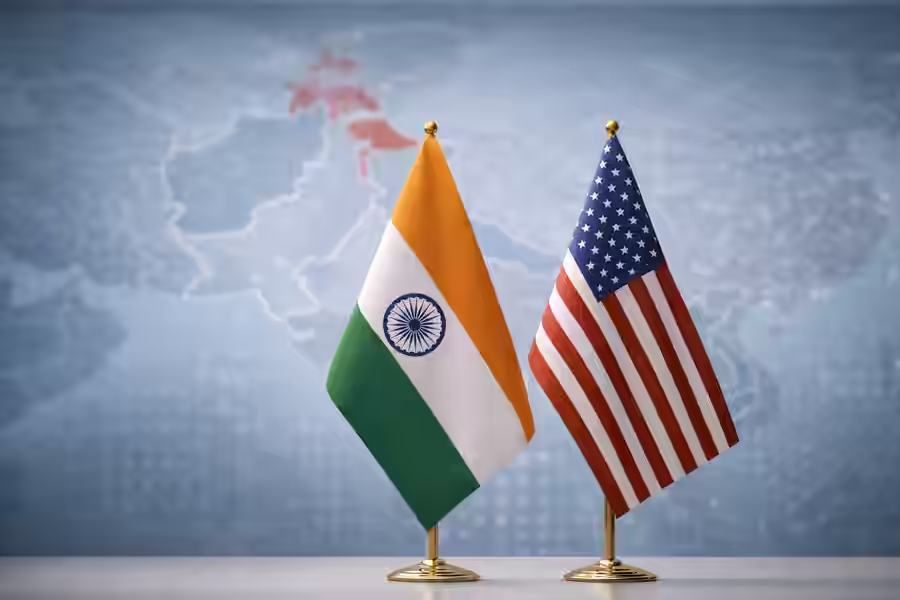
The United States Trade Representative office has deleted a social media content that had temporarily gained some form of attention by showing a map of India in accordance with the official stand of New Delhi on Jammu and Kashmir and Ladakh.
The image, which was released on February 7, as a part of an announcement on a provisional bilateral trade system, portrayed the whole region, encompassing Pakistan-controlled Kashmir and the Aksai Chin, as part of India. Later the post was deleted without any explanation.
What had shocked most observers about the map was that it seemed to follow a long-established cartographic tradition of Washington to depict the portions of the Himalayan region as contested.
PoK and Aksai Chin were traditionally presented with boundary markings or notations in the previous representations issued by different government bodies in the US, claiming competing claims to the region by India, Pakistan and China. The one posted by the USTR however had no such demarcations.
The picture was supported by the data about tariff cuts and other details of the developing trade understanding between New Delhi and Washington. It soon went viral, and analysts and strategic commentators were arguing over whether the depiction was the tiniest of diplomatic messages or it was just an oversight on the part of the preparer.
Other analysts saw the action as a geopolitical act to India during the period when the United States has been in bad terms with both Pakistan and China.
Some stated that one should not read too much into one graphic because it could have been an accident instead of a deliberate change in policy. The fact that the post was now gone has made the discussion even more questionable.
The deletion seems to bring back ambiguity, as opposed to clarity. Lacking any official explanation by the USTR or the State Department, it is not clear whether the initial map was an internal rethink of how the US went about the territorial dispute publicly or whether it was not compatible with current instructions.
In the case of India, Jammu and Kashmir and Ladakh is a non negotiable issue. Several times the New Delhi has stated that the whole Union Territory was, is, and will always remain, a part and parcel of the country.
The government also asserts that Aksai Chin, which has been within the Chinese control since the war in 1962 is a part of India. Even foreign maps have often been protested by Indian officials which in their perception, weaken or challenge this assertion.
Cartography has been a very delicate matter in diplomacy that has been perceived to be more of a political stance than a straightforward geography. Even a few differences in the boundary markings can cause controversy especially in areas where conflict has been experienced in the past.
The presence and later deletion of the USTR post were therefore given disproportional attention. It is not clear whether it was a symbolic nod or a drafting lapse or both but unless Washington clarifies this then it might remain unknown.
Also Read: New Government Rules Say Vande Mataram Must Be Sung at Official Events
Until further notice, the episode can be used as a reminder of how closely such representations are surveillance and how fast they may be turned into a bigger strategic discussion.