
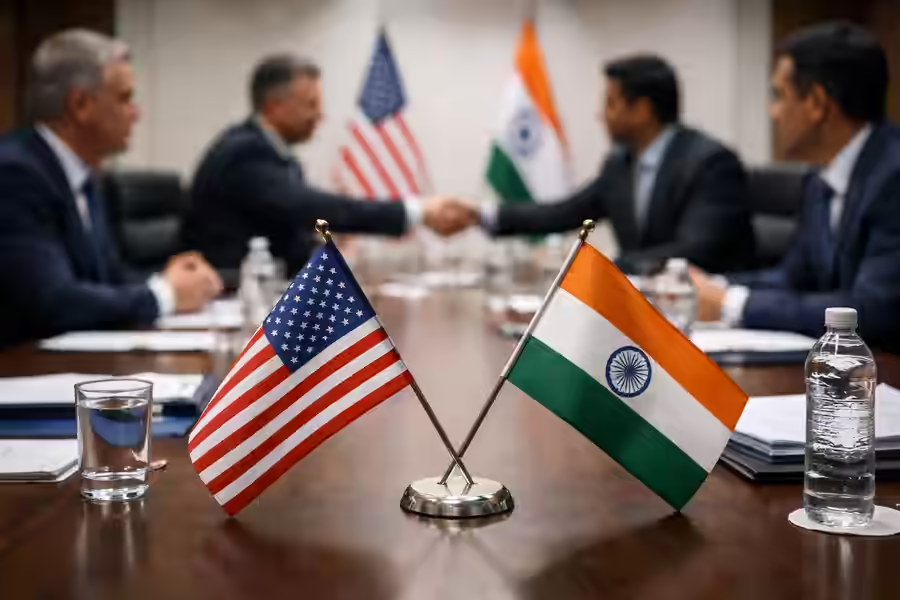
US President Donald Trump took everyone by surprise by announcing the unexpected US-INDIA trade deal. The impasse persisted after numerous rounds of negotiations, even after the US imposed 50% tariffs. The Trump administration insisted that any trade agreement with India would be contingent upon New Delhi ceasing to import crude oil from Russia.
While applauding the announcement of a lower 18% duty on Indian goods, Trump made no mention of Russian crude oil imports in his social media post on Truth Social, claiming that India had committed to stop purchasing petroleum from Russia.
India-US Trade deal : What was the trigger?
The Donald Trump administration was under pressure from the recently concluded India-EU Free Trade Agreement (FTA) negotiations, according to a News Week investigation. It said that was the reason the US blinked first and consented to a trade agreement with India.
According to the research, New Delhi recently concluded what Brussels called a “landmark” free-trade agreement. India’s negotiation position was enhanced, but the Trump administration was concerned about being left out. The FTA has indeed been referred to be the “mother of all trade deals” by both the EU and India.
Just a few days prior, PM Modi had publicly praised the India-EU agreement, describing it as a major development that “opens new pathways for growth, investment, and strategic cooperation.”
According to the News Week research, the order of events was intentional. Sergio Gor, the recently appointed US ambassador to India, alluded the impending news in a quick message just before the announcement:
Prime Minister Modi and President Trump just had a conversation. Remain tuned. Investors and politicians took notice when the deal quickly followed. The message was unmistakable: the highest levels were directing the deliberate recalibration of ties.
From the US point of view, the problem involves both geopolitics and energy policy. The White House has stated clearly that reducing tariffs is related to the goal of reducing Russia’s oil profits. Recently, US Treasury Secretary Scott Bessent claimed that India’s imports of Russian crude had “collapsed” and suggested “a path” for the sanctions to be lifted.
According to the Associated Press, the strategy is to squeeze Russia’s oil earnings in order to put more pressure on the Ukrainian conflict to end. Trump also mentioned other supply channels, like Venezuela, in order to avoid a spike in world prices. By the way, Trump said on Saturday that India has consented to purchase Venezuelan oil.
He also stated this in his Truth Social post announcing the trade agreement. In his Truth Social post announcing the trade agreement, he also stated that India would buy more US oil and would eventually buy Venezuelan oil.
According to recent sources, Tehran worries a possible US assault may destabilize the regime, highlighting how any shock in the Gulf can swiftly send shockwaves through the world’s oil markets. This assessment bears additional weight as the US manages risks associated with Iran, the analysis stated.
According to the US, the problem transcends geopolitics and energy policy. Treasury Secretary Scott Bessent, who stated that India’s imports of Russian crude had “collapsed” and indicated “a path” for lifting the tariffs, reaffirmed the White House’s position that lowering tariffs is connected to the goal of reducing Moscow’s oil earnings.
The strategy was summed up in stark terms by the Associated Press: Trump cited alternate supply lines, including Venezuela, to stop a spike in world prices, while reducing Russia’s oil revenue to build pressure for an end to the crisis in Ukraine.
With recent reports suggesting Tehran thinks a possible US assault could destabilize the regime, this calculation bears additional weight as Washington manages risks associated with Iran, highlighting how any shock in the Gulf can quickly ripple across energy markets.
Iranian authorities are worried that even targeted US military action might jeopardize the stability of the government, as tensions surrounding Iran heighten the sense of unpredictability. Separate reports, however, indicate that US-Iranian nuclear talks have resumed, highlighting how any Middle East flare-up may swiftly shock oil prices and complicate the politics of international alliances.
Both sides benefit politically from the India-US trade agreement. According to the study, Modi obtains tariff concessions and a clearer route for Indian exports, while Trump secures a narrative of using leverage to promote peace on Russia.
Also Read: Two Female Suicide Attackers Identified in Baloch Militant Group Photos
Beneath that surface, however, is a larger strategic calculation about supply chains: the research concludes that the US is eager to secure India as a manufacturing and defence partner outside of China’s sphere, and India wants quick, concrete proof that stronger ties with the US provide results.