
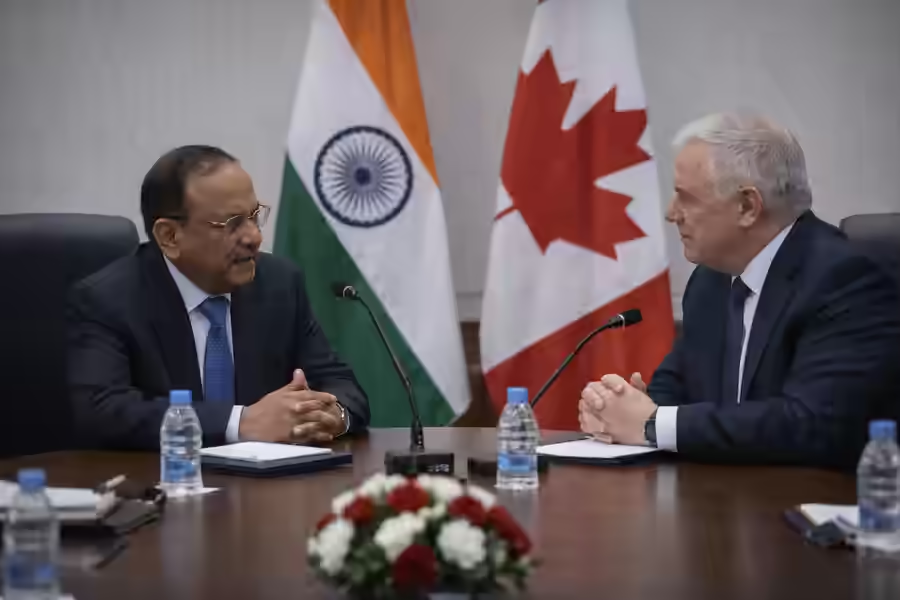
India and Canada have made new strides in the repair of their battered relationship with National Security Adviser Ajit Doval conducting high-level meetings in Ottawa on February 6 and 7 where discussions were centrally brought around rebuilding the structured cooperation in the security, intelligence and law enforcement.
The talks were a positive though tentative symbol of both parties trying to regain some trust following almost two years of diplomatic storm.
On February 7, Doval reportedly had a meeting with Nathalie Drouin, Deputy Clerk and National Security and Intelligence Adviser to the Canadian Prime Minister, which the officials claimed was a normal bilateral security meeting.
A day before, he attended a meeting with Gary Anandasangaree who is the Minister of Public Safety in Canada. A government spokesman indicated that the exchange of ideas was futuristic and was to enhance mechanisms to safeguard citizens in the two nations.
The two governments recognized the gains already achieved in the process of restoring working-level engagement and agreed on the common plan of work, which can be used to organize the cooperation on the issues of national security and policing. The framework will transform political will into the coordination of agencies in a practical manner.
Among the greatest results of the visit was the agreement between both nations that they were to appoint special security and law-enforcement liaison officers.
Such officials will be mandated to enhance the overall coordination within the day to day operations, speed up communication lines and facilitate faster exchange of information on potentially mutually significant threats.
The priority areas that were identified included the unlawful trafficking of narcotics, primarily the fentanyl precursors, and the operations of the transnational organised crime networks. According to the officials, the improvement of the real-time intelligence cooperation would enable both governments to respond better to the upcoming threats.
One more topic that was also a center of discussions was cybersecurity. India and Canada promised to institutionalise cooperation on cyber policy and increase information sharing, which shows an increasing centrality of digital threats to national security.
The two parties also promised to keep on the debate on fraud prevention and immigration enforcement without going against the domestic law and international requirements.
The outreach is in the context of the diplomatic break in 2023 following the murder of Khalistani terrorist Hardeep Singh Nijjar in Canada.
The Canadian leadership of the time accused the Indians of potential involvement in the happenings but this accusation was strongly denied by New Delhi leading to counter-measures of expulsions, trade talks and a long term freeze on top-level contacts.
Since that time the two capitals have crept slowly towards stabilisation. The renewed security discourse was also predetermined by the reestablishment of full diplomatic representation through appointing high commissioners and reinstating the exchange of ministers.
This could be followed by further momentum in the following month when the Canadian prime minister Mark Carney is due to visit India. His trip will probably broaden the discussion beyond security to energy, essential minerals, nuclear collaboration, new technologies, education and cultural relations.
According to a statement made by Canadian Energy and Natural Resources Minister Tim Hodgson the relationship is a strategic imperative as India has a fast-growing energy demand with Canada being the most apt supplier of liquefied natural gas, uranium and other resources.
Also Read: Delhi Schools Evacuated After Bomb Scare, Security Search Underway
A significant community of Indian origins serves as a social connector, so both sets of policymakers seem interested in framing the reset in long-term, practical associations. According to the officials, this visit by Doval is a significant move in that direction.
Image used for representation purpose only