
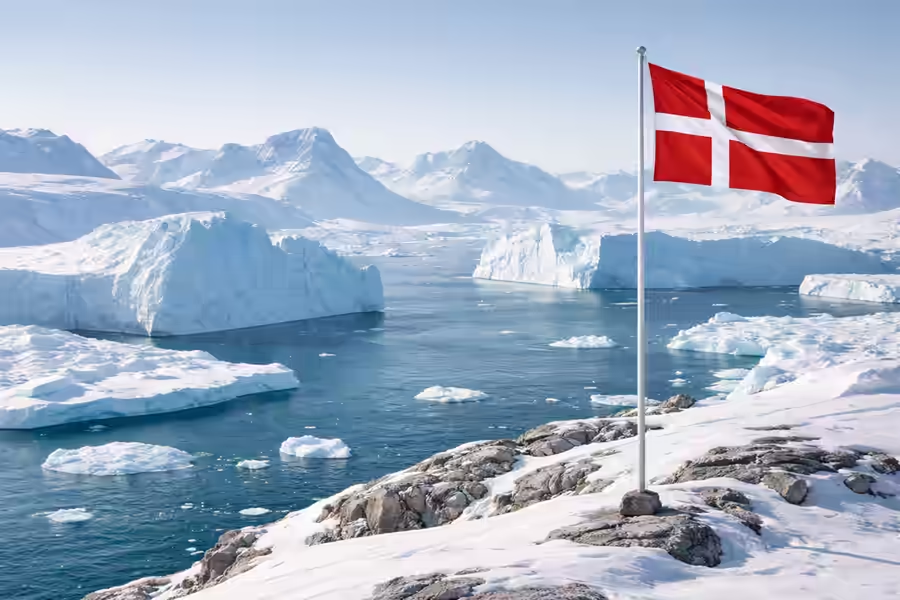
Greenland was at the centre of a growing global standoff when Denmark issued a warning of a critical turning point moment. As Trump continued with his threaten over the territory in the Arctic and the European allies tightly banded together.
Denmark Prime Minister Mette Frederiksen told media they are at a decisive moment moment for the future of Greenland after Donald Trump, former President of the United States, once again threatened to seize the Arctic territory.
The Danish leader told early Washington, DC, meetings on Monday that the Greenland situation has turned into an open conflict.
The talks in Washington are for competition at the world level focusing on raw materials, many of which are found in the Arctic region. This is a decisive moment, Frederiksen said during a debate with other Danish political leaders.
The Prime Minister pointed out that the issue is not just about Greenland but also brings up very serious questions about international law, security, and respect for sovereignty.
Speaking on Facebook, the prime minister said Denmark was prepared to defend its values wherever necessary, also in the Arctic. She said that Denmark has strong confidence in international law and that the peoples have the right to decide their own future which is obviously making a reference to Greenland right to self, determination.
Trump has always asserted that control of Greenland would support US national security interests by keeping a watchful eye on the increased military presence of the Russian and Chinese militaries in the Arctic region.
He recently reiterated this hard-nosed approach, stating that Washington would take action on Greenland, whether the Danes approve of that action or not. Greenland is a self-governing territory of the Kingdom of Denmark. Denmark controlled Greenland as a colony until 1953, when it became a home rule territory.
Discussions are still on-going between the Danes and Greenlanders concerning the degree of independence the Greenland territory will ultimately have from Denmark. Surveys conducted over the years show that most Greenlanders are strongly opposed to becoming a part of the US.
Denmark has received backing from multiple European nations in response to Trump’s statements regarding Greenland. Swedish Prime Minister Ulf Kristersson strongly condemned the US’s threatening rhetoric regarding the issue of Greenland during a defence conference in Salen. Kristersson indicated that Sweden, other Nordic nations, the Baltic States and many major European countries fully support Denmark with respect to Greenland.
In warning against a takeover of mineral-rich Greenland by the US, Kristersson indicated that such an action would be a violation of international law and could open the door for other nations to use military force in order to obtain their objectives.
Germany also expressed continued support for Denmark and Greenland in anticipation of the Washington talks. German Foreign Minister Johann Wadephul has engaged in discussions with Icelandic officials about what Wadephul has characterised as the strategic challenges of the Far North.
He said security in the Arctic is becoming increasingly important and is part of NATO’s shared interests. Meanwhile, reports in the UK suggest that European military leaders are quietly discussing possible NATO involvement in Greenland. According to The Telegraph, early-stage talks have taken place between the UK, Germany, France and other countries.
These discussions reportedly include plans that could involve deploying troops, warships and aircraft to protect Greenland from threats linked to Russia and China. UK Transport Secretary Heidi Alexander said conversations about deterring Russian aggression in the Arctic are routine. She described the Arctic as an increasingly contested geopolitical region and said NATO allies regularly discuss ways to respond to security risks there.
Also Read: How Can We Clean Up Space Junk and Protect Earth’s Orbit from Debris
Belgium’s Defence Minister Theo Francken has also called for NATO to launch a specific Arctic operation. He said NATO must show unity and strength, suggesting a new “Arctic Sentry” mission similar to existing NATO surveillance operations in Eastern Europe and the Baltic region.