

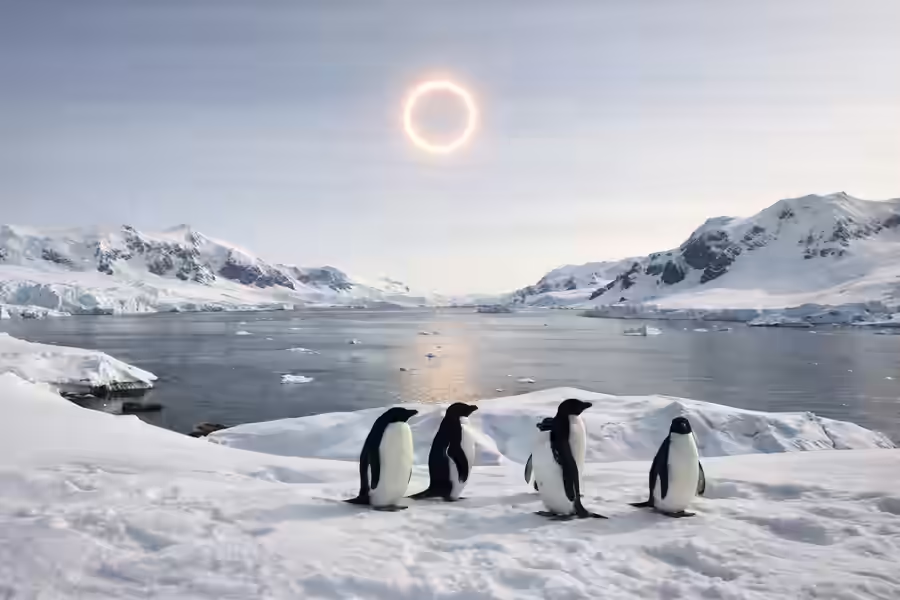
Location is important when the sky throws on a rare celestial spectacular, and penguins are obviously favored by geography this time. The first solar eclipse of 2026 will be a spectacular “Ring of Fire” annular solar eclipse that will occur on February 17.
The most spectacular view of this event will occur over the ice avenues of Antarctica, distant from bustling cities and busy streets, although skywatchers from all over the world may hope to get a glimpse.
Penguins and polar researchers will thus have a firsthand look at a phenomenon that most of humanity will not see at its most brilliant.
What Is a Solar Eclipse?
When the Sun, Moon, and Earth line up in a straight line, it’s called a solar eclipse. The Moon will be in the middle, and when it moves between the other two, it blocks our view of the Sun and momentarily casts a shadow on Earth.
Additionally, there are four different kinds of solar eclipses: hybrid, annular, partial, and complete. The Moon’s distance from Earth and the precision of the alignment determine the type that is seen.
Why It’s Called a “Ring of Fire”
An annular solar eclipse is sometimes known as the ring of fire, and this term accurately describes the phenomena. The Moon is at or near its furthest point from Earth during such an eclipse. Because of this, it doesn’t completely obscure the Sun as we perceive it when it moves between the Earth and the Sun, leaving a dazzling ring of light in its wake. This bright circle is what distinguishes an annular eclipse.
Exact Timing of the February 17 Eclipse
The annular solar eclipse on February 17 is predicted by TimeAndDate to begin at 9:56 am UTC, approach annularity the point at which the Moon is directly in front of the Sun at 12:12 pm UTC, and conclude at 2:27 pm UTC. The ring of fire will only be visible for a short time and only in a certain area, even if the eclipse lasts for many hours from start to finish.
Why Penguins Are Getting the Best View
Only from Antarctica will one be able to observe annularity. The ring of fire will be visible along an annularity route that is nearly 2,661 miles (4,282 kilometers) long and 383 miles (616 km) wide.
This slender route skirts the Southern Ocean’s Davis Sea coast and passes into western Antarctica. Since there are no permanent habitations in this region, the wildlife of Antarctica is able to observe it more clearly and directly than nearly anyone else on Earth.
Who Will See a Partial Eclipse?
Only a portion of southern Africa and parts of South America will be able to witness a partial view of the eclipse. However, about 176,000,000 people (along with a few penguins) will be able to see any part of the eclipse, which is a significant number.
Beyond land, spectators will be able to see the Moon take tiny bites out of the Sun as the partial phase is visible over parts of the Pacific, Indian, Atlantic, and Southern oceans as well as across Antarctica itself.
What Comes Next?
Only a portion of southern Africa and parts of South America will be able to witness a partial view of the eclipse. However, about 176,000,000 people (along with a few penguins) will be able to see any part of the eclipse, which is a significant number.
Also Read: Isha Ambani Turns Heads in Pastel Pink Bridal Lehenga Look
Beyond land, spectators will be able to see the Moon take tiny bites out of the Sun as the partial phase is visible over parts of the Pacific, Indian, Atlantic, and Southern oceans as well as across Antarctica itself.