
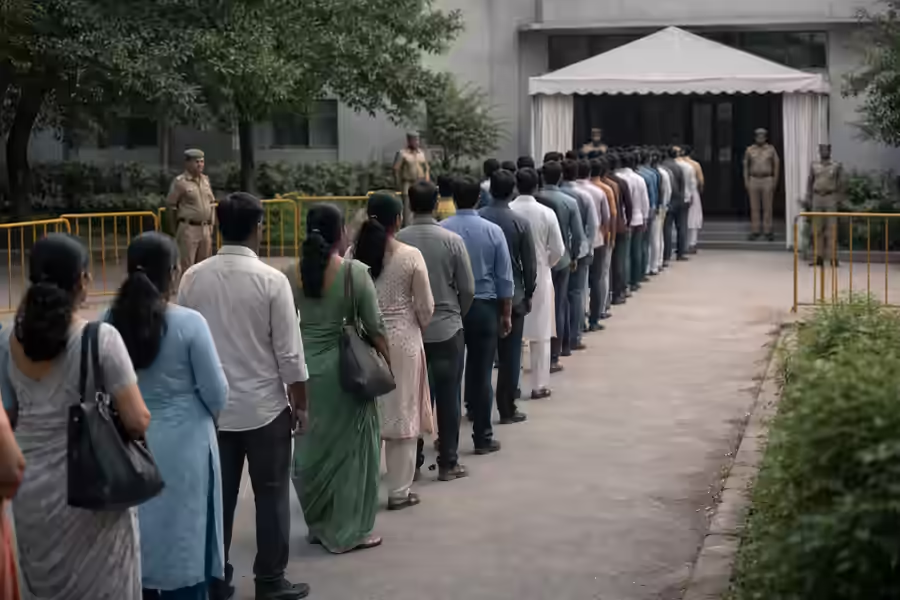
Bangladeshis queued outside polling stations across the country on Thursday as voting began in what many are calling a landmark general election, the first since the removal of long time prime minister Sheikh Hasina after a youth led uprising last year.
Polling opened at 7:30 in the morning in 299 of the 300 parliamentary constituencies and will continue until 4:30 in the evening. Voting in one seat has been postponed because a candidate died. Counting will begin soon after the polls close and results are expected to become clear by Friday.
The election marks Bangladesh’s return to electoral politics after months of turmoil that followed the deadly protests of 2024.
The unrest had affected important sectors of the economy, including the garment industry, which is the world’s second largest apparel export hub. Analysts believe that a clear mandate from voters is essential to restore political stability in the country of about 175 million people.
This vote is also being described as the first national election in the world after a movement largely driven by people under the age of thirty.
In the capital Dhaka, voters began lining up even before polling booths opened. Mohammed Jobair Hossain, who is 39, said it was his first opportunity to vote since 2008. He said he felt excited because people were finally able to vote freely after many years and believed that their choices would now carry real meaning.
The main contest is between two coalitions led by former allies, the Bangladesh Nationalist Party and the Islamist Jamaat e Islami. Opinion polls suggest the BNP may have an advantage. The Awami League, once led by Hasina, has been dissolved and is not allowed to contest. Hasina is currently living in self imposed exile in India.
More than 1,700 candidates from 50 political parties, along with 273 independents, are competing for 300 seats in the Jatiya Sangsad, the national parliament. The BNP has fielded the highest number of candidates. Only 83 women are in the race, even though women make up nearly half of the voters.
Alongside the election, citizens are also voting in a referendum on an 84 point package of constitutional reforms.
The proposals include setting up a neutral interim government during elections, creating a second house of parliament, increasing representation for women, strengthening the independence of the judiciary and limiting the prime minister to two terms.
Muhammad Yunus, the Nobel laureate who heads the interim government formed after Hasina’s removal, said earlier this week that the vote represents a constitutional expression of the public awakening against inequality and injustice.
Security has been tightened across the country. Authorities have deployed between 900,000 and one million personnel from police and armed forces to maintain order.
Armoured vehicles, rapid action teams, drones and body cameras are being used. In Dhaka, police have identified more than 1,600 polling centres as sensitive.
Chief Election Commissioner AMM Nasir Uddin urged citizens to vote freely and appealed for peace. Observers from 45 countries and international organisations are watching the process.
Although the campaign period remained largely calm, some voters expressed mixed feelings. A rickshaw puller named Chan Mia said he could not afford to travel back to his village to cast his ballot. Others said they were disappointed that the Awami League was not part of the race.
Even so, many people said they were determined to take part. Shakil Ahmed, a driver, said that in earlier years he had not been able to vote, but this time he would not give up his right.
Also Read: Russia Bans WhatsApp in Move Affecting 100 Million Users; Will Ban Be Reversed?
With issues such as corruption and rising prices dominating public debate, experts say the fairness of the process and the willingness of parties to accept the result will be crucial.
Thomas Kean of the International Crisis Group said that if the election is conducted impartially and its outcome is respected, it would be strong evidence that Bangladesh is moving toward democratic renewal.