
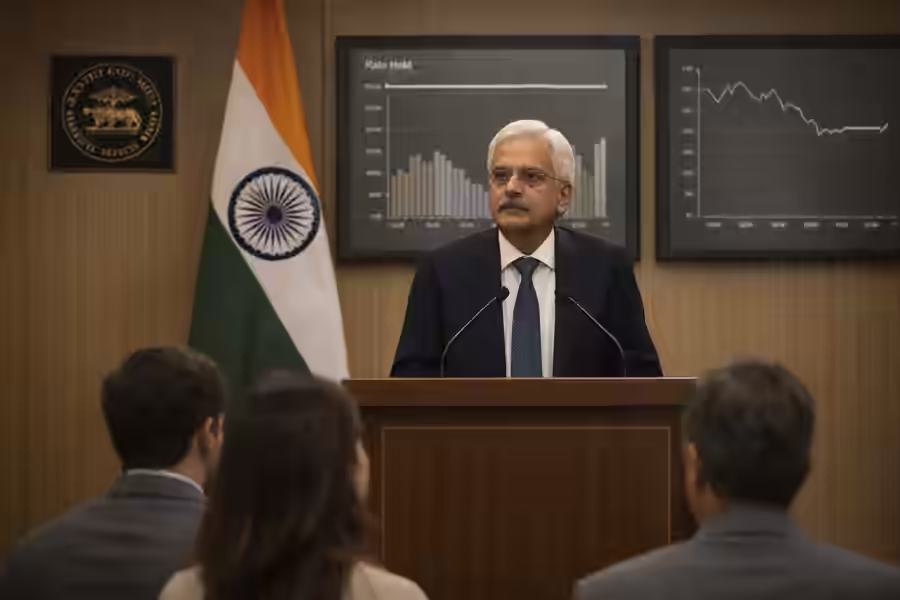
The Reserve Bank of India on Friday maintained its principal policy repo rate of 5.25 percent indicating that it is hesitant yet stable in its decision-making since it has to balance its inflation control with ensuring that the economy grows.
At its meeting on February 6, 2026, the Monetary Policy Committee (MPC) made the unanimous decision announced by the Governor of RBI, Sanjay Malhotra.
This was the first policy review to be followed since Finance Minister Nirmala Sitharaman introduced the Union Budget of 2026-27. According to Governor Malhotra, MPC resolved to adopt a neutral position based on a careful evaluation of the changing macroeconomic factors, international uncertainty and the economic prospects of the country.
Although the Governor recognized the escalation of external head winds since the last time the policy meeting was held, he sounded an optimistic tone on the overall economic strength of India.
He cited the recent trade agreements that have been successful as a good element that will facilitate growth. In his opinion, the domestic inflation and growth trends are favourable, and this leaves it with room to continue with the policy.
The progress of the economy saw the RBI changing the growth outlook upwards in the two following quarters. Malhotra said that real GDP growth in the next two quarters has been revised because the Indian economy still illustrates strength amidst the global turmoil.
The inflation of consumer price index was also estimated by the central bank to reach 2.1 percent in 2025-26 which means that the price pressures are in a comfort zone of the RBI.
In its last session on December 5, 2025, the MPC brought down the repo rate by 25 basis points to 5.25 percent in an effort of boosting growth as inflationary pressure eased. The decision by the central bank to hold on Friday indicates that the central bank is currently examining the effects of the previous easing with a keen eye on the happenings in the global front.
In addition to the interest rates, the Governor also presented a number of regulatory and developmental actions. One of them was a proposal to establish a single portal to enhance the management and monitoring of Lead Bank information with an aim of enhancing credit delivery and financial inclusion.
The RBI also announced that it would be increasing branch opening requirements in the non-bank financial companies a move that is likely to facilitate access to credit, especially in the underserved regions.
In yet another major move, Malhotra indicated that banks will be allowed to lend to real estate investment trusts but with certain protection. This will serve as an extra financing to the real estate industry and will also stabilize the financial situation.
The Governor indicated that the RBI would be proactive to fulfil the productive needs of the economy, on the liquidity conditions. The liquidity in the system was averaged at approximately 75 crore in a single day and the central bank had made a number of steps in December and January in order to increase the liquidity.
Also Read: Valentine’s Week 2026 – All 7 Days From Rose Day, Kiss Day to Propose Day
In addition, Malhotra emphasized the power of the external position of India whereby foreign exchange reserves were at a healthy level of 723.8 billion by the end of January. The high reserves, he argued, have a buffer effect against international financial turmoil, and adds to macroeconomic stability.
In general, the current policy position of RBI can be deemed as a cautious mix in favor of economic growth and financial security in an unpredictable world of the global economy.