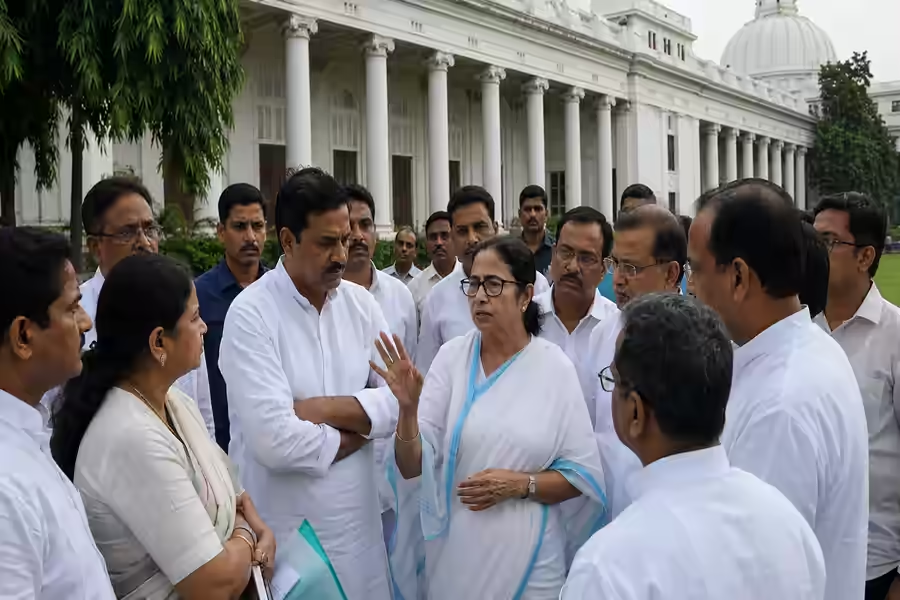


On Tuesday, January 27, 2026, banking services at most of the public sector banks in India are likely to be affected due to a nationwide strike by the bank employees. The demand to have a five day work week put in place immediately is the core of the protest.
The strike follows the failure of negotiations with the Chief Labour Commissioner to come up with a solution. It is also preceded by two successive holidays, a factor that increases the chances of customers experiencing three days of sparse access to the services of the branches.
The United Forum of Bank Unions, also referred to as UFBU has called the strike. This body is an umbrella body of nine other unions which are collectively representative of officers and staff on the public sector banks across the country.
A conciliation meeting that was carried out on January 23 failed to bring any resolution between union representatives and authorities, thus the decision to go on strike was reached.
The grievance that led to the protest is the fact that since time immemorial, there has been a call to declare every Saturday a bank holiday. According to the employees of a bank, such a step is necessary to enhance the balance of work and life in the banking sector, and to align banking work schedules with those of most other industries which are based on a five day working week.
In March 2024, the 12th Bipartite Settlement between bank unions and the Indian Banks Association included the proposal of making Saturdays a holiday. But this change is not yet actually implemented as it needs formal approval and government notification to be implemented.
Currently, banks close on the second and fourth day of every month but operate on the first, third and fifth days. Unions claim that this system is obsolete and imbalanced and that a five day week would be more realistic and effective to the staff, and to the productivity at large.
Unions claim that the government has not made any formal action to effect the agreed change, thus leaving them with the only option to strike.
Although January 27 is not a bank holiday, the strike will probably have an impact on the work of some large banks operating in the public sector. There might be a decrease in the number of individuals at the branches of institutions like State Bank of India, Punjab National Bank, Union Bank of India, Canara Bank, and Bank of Baroda.
This would lead to delays or inconveniences in services such as cash deposits, cash withdrawals, cheques cleared, account related work, and loan applications at the physical branches.
There will be no impact on the private sector and foreign banks to the same proportion, with the workers of the public sector banks being the primary participants in the strike. Depending customers who rely on the branches of the public sector because of the routine transactions might need to change their plans.
Internet banking, mobile banking, and ATM transaction services are the digital banking services that will probably remain in operation, as they are not directly dependent on the in branch staff. Nevertheless, there is a possibility that some back end processes might slow down the normal speed when even the support teams are still hit by the strike.
The customers who have urgent banking requirements are encouraged to enquire their local branches before coming to visit because availability of services will differ depending on whether the staff are participating in the strike.
Also Read: Deadly U.S. Snowstorm Leaves At Least 30 Dead as Freezing Cold Continues
It puts the current conflict between employees and authorities on one side and working conditions on the other into the spotlight, and the further course of actions will be determined by the possibility of new negotiations and finding a solution within the nearest future.