
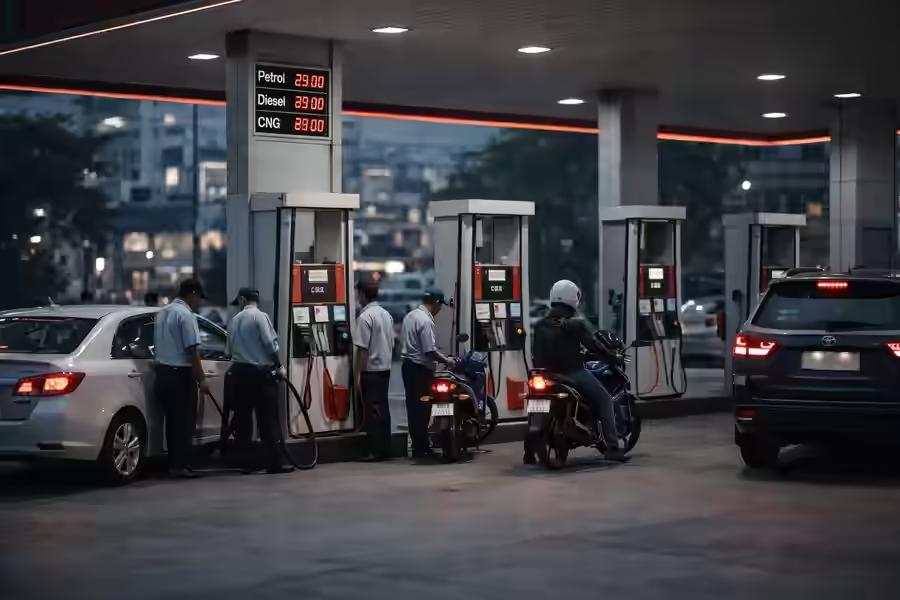
Despite international worries over the Iran-US confrontation, petrol and diesel prices in India will stay steady for the time being. According to the source, the government has implemented a fuel supply management chain mechanism to manage any emergency.
Regarding the current conflict’s impact on the Strait of Hormuz shipping route, the source stated that India has boosted its sourcing from non-Hormuz regions from 60% to 70% in order to lessen its reliance on the Middle East.
Previously, the Middle East accounted for about 40% of supplies, but efforts to diversify are currently in progress. India has begun getting gas and oil from other nations due to the unrest in the Middle East.
The insider continued, The recent gas price increase is marginal, not a major spike, in response to the LPG price increase. There is enough stock on hand to satisfy public demand, and no LPG distributor in the nation is dry.
The government is very strict on black marketing, the government source with knowledge of the situation added. There are systems in place to stop fuel and LPG from being sold illegally. When it comes to gasoline and LPG supply, domestic customers continue to be the government’s top focus.
Strait of Hormuz Critical For India
Less than a day has passed since a Thai-flagged cargo ship headed for India was assaulted close to the Strait of Hormuz just after departing a port in the United Arab Emirates.
Interestingly, 60% of India’s overall LPG needs are met by imports, with suppliers in the Middle East often accounting for 80-90% of these imports. Major Indian cities saw increases in both home and commercial LPG prices since the majority of Gulf-origin LPG passes through the nearly blockaded Strait of Hormuz.
As oil marketing businesses absorb the losses, retail fuel prices at the pump have not altered for the time being. But this month, India updated its consumer price index (retail inflation), combining housing, gas, and gasoline for a total weight of 17.7% as opposed to 16.9%.
Petroleum Minister Hardeep Puri told the Lok Sabha on Thursday that although the Strait of Hormuz has been closed to commercial ships for the first time in history, India’s petroleum supply is still safe.
Panic on LPG supply is driven by consumer anxiety rather than supply shortage, Puri explained in response to worries about panic buying, adding, There is no shortage of petrol, diesel, or kerosene. Supply chains are running smoothly, and fuel retail locations are fully stocked.
Puri emphasized the effect of the Prime Minister’s diplomatic actions, saying that India had obtained more oil than the blocked Strait could have provided. LPG output has risen by 28% in the last five days, and non-Hormuz sources now supply 70% of crude imports, up from 55% prior to the crisis. Almost every day, large LNG shipments arrive via different routes.
Puri emphasized the effect of the Prime Minister’s diplomatic actions, saying that India had obtained more oil than the blocked Strait could have provided.
LPG output has risen by 28% in the last five days, and non-Hormuz sources now supply 70% of crude imports, up from 55% prior to the crisis. Almost every day, large LNG shipments arrive via different routes.
In the history of energy, the world has never confronted a situation like this, according to Puri. With refineries operating at full capacity, India is sourcing cargo from the US, Norway, Canada, Algeria, and Russia. To relieve strain on gas and LPG, other fuels are being used.
Crude and fuel supply
India now imports safe and diverse crude from 40 countries, up from 27 in 2006-07. Because refineries are running at full capacity, fuel oil, kerosene, diesel, gasoline, and aviation turbine fuel are always available. States have received more PDS kerosene.
Natural gas and LPG
Alternative LNG imports are used to augment the 90 MMSCMD of natural gas produced domestically. There are no interruptions to the 100% supply of domestic piped gas to homes and CNG for vehicles.
Fertilizer plants and power generation are completely supported, according to Puri, who added that industrial and manufacturing clients will receive up to 80% of their prior six-month average.
Puri emphasized that localized rush reservations are more a reflection of customer worry than of supply problems. To stop hoarding and black marketing, policies like Delivery Authentication Codes and minimum booking gaps for urban and rural areas have been implemented.
Commercial LPG and alternate fuels
In collaboration with state governments, 20% of the average monthly commercial LPG requirement will be allotted to prevent diversion. For a month, alternative fuels such as kerosene, fuel oil, biomass, and RDF pellets will be made available to industrial and hospitality customers in order to provide priority consumers with free LPG.
Consumer prices and state coordination
India is navigating the most severe global energy disruption in recorded history, Puri said. The supply of crude is flowing. For homes and farms, gas is given priority. The production of LPG has increased by 28%. Prices for consumers are kept well below market levels. Schools are open.
Also Read: Cyber fraud cases rise as scammers target ITR filing, tax refunds
The forecourt is filled with gasoline. Every citizen is interested in that. India must unite in support of the institutions handling this issue, its energy warriors, and the country’s interests.