
On Saturday, Prime Minister Narendra Modi made a historic step towards the strategic preparedness of the Northeast as his aircraft landed at the first Emergency Landing Facility in the region, at Moran.
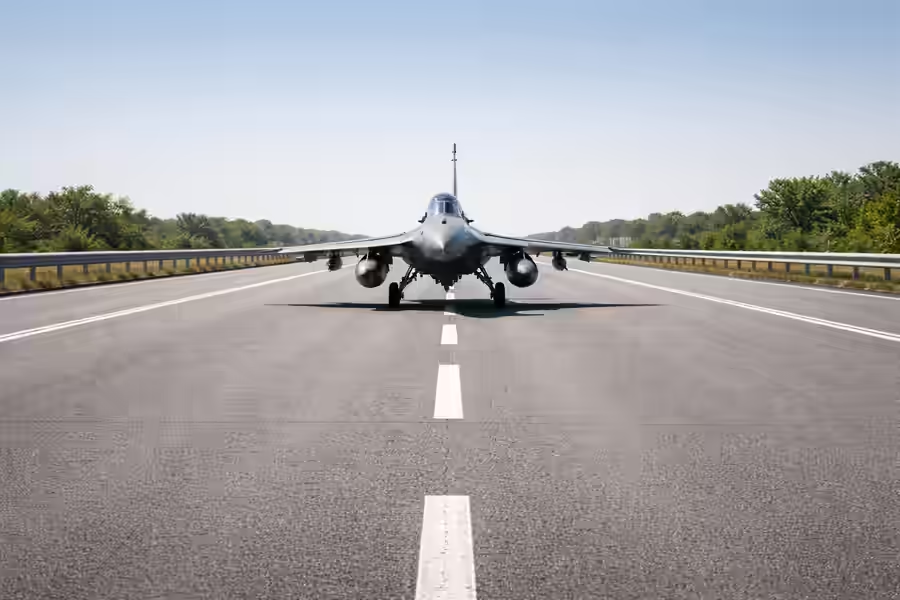
The specially created airstrip, constructed along the national highway bypass, is designed to enable fighter jets and transport aircraft to land and take off during emergencies, improving defence mobility and disaster response capacity.
The landing of the Prime Minister officially opened up the 4.2 kilometre site, the first of its kind in the Northeast.
Authorities reported that the project will be a significant move towards the harmonization of critical infrastructure and operational military needs as well as maintaining a backup against civilian emergencies. The stretch also plays the role of substitute air as an alternative in the event of unavailability of regular airports.
Modi had earlier in the day touched down at the Chabua airfield and then boarded an Indian Air Force C-130J transport plane to arrive at Moran.
Emergency Landing Facility costing approximately crore 100 has been erected. It has a dual use nature and hence can be used in times of crisis to help provide routine connectivity requirements whilst also being prepared to handle strategic deployments at short notice.
The airstrip is designed to accommodate fighter jets of up to 40 tonnes and carrying planes of a maximum take off weight of 74 tonnes. Defence planners consider such infrastructure a key to enabling a swift response capability especially in the frontiers where terrain and weather may make the traditional air operations difficult.
After the inauguration, the Prime Minister was able to observe a massive aerial demonstration by the Indian Air Force. The forty-minute demonstration brought out the capability of the combat and support aircraft to smoothly interoperate between highway based facilities. Another objective of the exercise was to introduce the local authorities to the logistics of combined civil military use.
There were fly pasts and operations on Sukhoi Su-30MKI and Dassault Rafale, two of the main pillars of the Indian air defense force. The Antonov An-32 transport operations showed how use of troops and equipment could be mobilised within a short period.
The simulations involving the advanced Light Helicopters were connected with the surveillance, rescue operations and humanitarian aid, which makes it clear that such tools are essential in floods, earthquakes and other disasters typical of the area.
The specialised capabilities would be vital in high risk operations as the elite Garud Commando Force of the Air Force also held precision drills.
Earlier, Modi had been received at Chabua by Lakshman Prasad Acharya, Himanta Biswa Sarma, Union Minister Sarbananda Sonowal and other senior officials. Besides the political significance of the visit, the welcome echoed the ongoing focus of the Centre on the connectivity and defensive preparedness of the Northeast.
The Prime Minister left after the programme to visit Guwahati where he will launch development projects worth over Rs 5,500 crore and hold meetings with people.
This day long visit is an amalgamation of strategic signalling and economic outreach and serves to underscore the message that infrastructure modernisation continues to be central to how the government pursues regional expansion.
Also Read: Isha Ambani Turns Heads in Pastel Pink Bridal Lehenga Look
As the Moran airstrip gets successfully operative, the authorities think that the Northeast has finally made a giant leap forward in terms of preparedness to guarantee a higher military mobilisation, better disaster relief access and greater integration with the national transport grid.