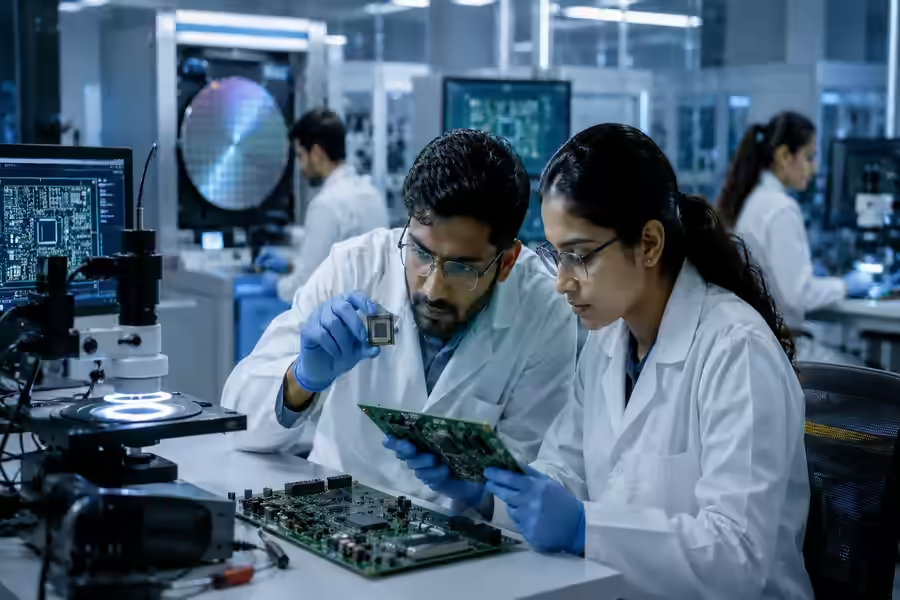


Nvidia has taken a bold step in artificial intelligence by giving all 30,000 of its engineers access to OpenAI Codex. This move is one of the largest companywide deployments of an AI system built to support software development. It shows Nvidia’s strong focus on boosting productivity and bringing automation into everyday technical work.
The program is in tandem with the official position of the company that Nvidia executives, particularly their chief executive Jensen Huang, has assumed many times over. He has contended that engineers ought to write less routine or repetitive code and do more high value problem solving, system design as well as innovation.
During in-house meetings, Huang has emphasized the importance of letting AI perform a process in case it can be automated. This, according to him, is not meant to replace human capability but augment it.
Feedback Nvidia Nvidia engineers turned in positive feedback. Codex is an open AI based on the GPT-5.3-codex model and is intended to handle a sequence of reasoning, and maintain context over a long session and successfully solve multi step programming problems without forgetting the requirements.
Software developers of intricate infrastructure and hardware frequently have to manipulate large codebases. Prompting tools that are capable of recalling previous prompts, being predictable and providing the right suggestions are considered to be of specific importance.
Some of the engineers have cited higher efficiency of the tokens and contextual awareness. Practically, it would imply fewer restarts, less manual correction and easier interaction of human developers with automated agents.
The technology will be useful to produce modules, propose bug fixes, create tests and documentation summaries, leaving teams with architecture choices and performance tuning.
OpenAI engaged Nvidia to put in place enterprise safeguards to make the deployment viable on scale. These involve centralized administrative management, strict levels of use controls as well as data processing being within acceptable infrastructure in the United States.
The extra fail safe systems have been installed so as to cut down the hazards surrounding reliability, confidentiality and abuse.
The alliance is indicative of a wider change that has already been happening at Nvidia. The pace quickened once Huang came out publicly attacking what he referred to as pockets of reluctance when it comes to AI adoption, in a companywide forum, in a late 2025.
Since that time, AI assistance has become a given throughout the software life cycle, including the early design phases up to debugging. Various teams keep trying various tools but currently Codex offers a common baseline functionality that is accessible to all.
The most interesting aspect of the decision is that it is issued when the controversy of AI and employment is still quite strong in the technology industry. Huang has attempted to allay the fears by focusing on growth as opposed to contraction.
Recently, Nvidia has employed thousands of workers, as he has observed, and it is still recruiting employees across the globe. Increased productivity, according to him results in a quicker product cycle, bolder projects and finally increased positions.
Industry observers indicate that such kind of moves have the potential to transform the nature of engineering organization.
When the proportion of the routine implementation can be torn off by AI systems, companies might focus on creativity, multi-disciplinary thinking and quick experimenting. Developers may have to take more time to validate ideas and less time writing boilerplate.
Also Read: Why Sonam Pandit Devotional Shivratri Reel Is Trending on Social Media
In the case of Nvidia, whose chip enabled the majority of the AI boom around the world, the advanced automation within the company does not have an empty purpose either.
It shows trust in the same ecosystem that the company assists in developing. With AI assistants in the hands of all engineers, it will essentially transform Nvidia into a guinea pig on the potential extent of augmented development.
The long term outcomes will be difficult to quantify. Yet the direction is clear. Nvidia does not wish AI to be pushed to the periphery of its workflow, but in the middle.