
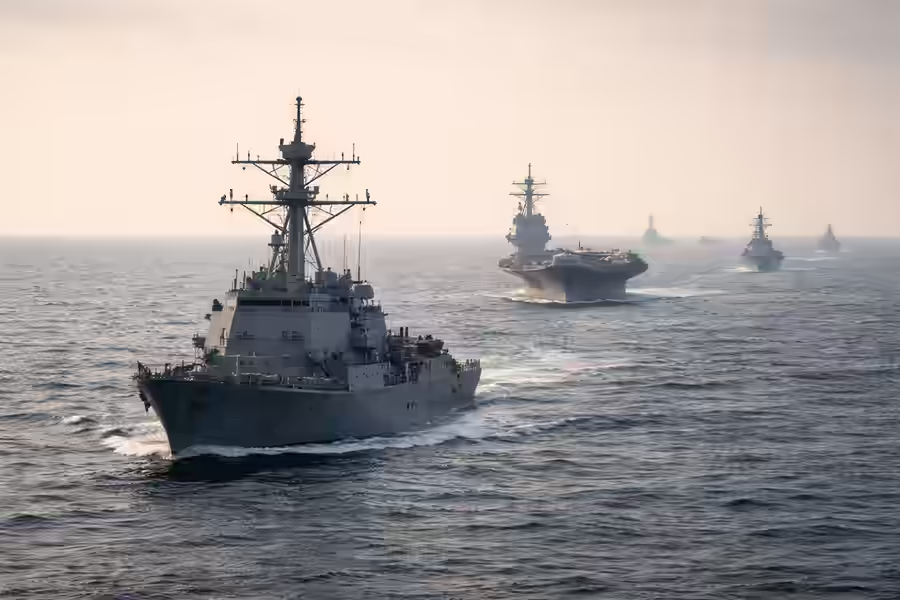
With the United States Navy Abraham Lincoln Carrier Strike Group still at work in the Arabian Sea, Washington is treading on fragile diplomatic ground as it approaches high stakes negotiations with Iran.
The white house has emphasized that despite the US indicating that it was willing to employ force in the event that no progress was achieved in negotiations, President Donald Trump is still dedicated to diplomacy.
At a press conference on Thursday, White House press secretary Karoline Leavitt indicated that diplomacy was the ideal way President Trump was handling Tehran. She added to the reporters that the administration is prepared to consider whether a compromise is possible at negotiations they are going to have in Oman, but she also said that the red line of the president is not going to be lowered.
As Leavitt describes, Trump has been very explicit that Iran should not have nuclear capability at all. Meanwhile, she cautioned that as commander-in-chief, the president has numerous avenues at her disposal in case diplomatic talks fail.
This is in the wake of increased military actions within the region. US Central Command announced that the USS Abraham Lincoln, the flagship of the Carrier Strike Group 3 and Nimitz-class nuclear-powered aircraft carrier, has been conducting normal flight operations as part of its regular deployment in the Arabian Sea.
Nevertheless, the situation has deteriorated earlier this week with the US fighter jets shooting down an Iranian drone that the officials stated had approached the carrier aggressively on Tuesday. The event has highlighted how the security environment is threatened prior to the diplomatic interaction.
The tensions have increased but both Washington and Tehran officials have confirmed that discussions would proceed in Oman on Friday. Already the negotiations are marred by acute differences over their extent.
The United States desires talks to be beyond the nuclear programme of Iran and encompass its development of missiles, the activities it is undertaking in the region and its human rights issues. Iran, however, has demanded that the negotiations should be narrowed down to nuclear matters.
The Iranian Foreign Minister Abbas Araqchi has also left Muscat with a diplomatic delegation as per the Foreign Ministry of Iran.
Preparations were being made before the meeting on Friday that is likely to see the meeting of Aarqchi and US representatives including the special envoy of President Trump Steve Witkoff and presidential advisor Jared Kushner.
Both sides seemed to be eager to show power on the eve of the talks. According to Iranian state media, Tehran had launched a Khorramshahr-4 long-range ballistic missile at an underground base being run by the Revolutionary Guards.
The action was largely regarded as a demonstration of strength to strengthen the bargaining table of Iran. The United States has been pushing Iran towards a drastic reduction of the range of its missiles, citing a national security need since it has been deemed a critical threat to the stability of the region and allies of the US.
Washington, in its turn, has strengthened military presence in the region. It has deployed thousands of more US troops, aircraft carriers, warships and surveillance aircraft. US officials claim that the use of deployments is to prevent aggression and defend American troops and interests, yet this has also provoked apprehensions of miscalculation.
The escalating tensions have motivated other players in the world and the region to engage in diplomatic efforts. Turkey President Tayyip Erdogan indicated that Ankara was making efforts to ensure that the situation did not deteriorate into an open conflict.
German Chancellor Friedrich Merz said he was very worried as he paid his visit to the Gulf, China wanted all parties to restrain themselves and spoke against the use of force. Gulf Arab nations have also raised concerns that any American attack against Iran would lead to counter attacks against US bases that are on their soil.
President Trump has also repeatedly threatened of bad things in the event of a failure in the talks and stated that the Supreme Leader of Iran Ayatollah Ali Khamenei would be very worried.
The tough stance has been reiterated by the US Secretary of State Marco Rubio, who says that a deal should not simply deal with the nuclear ambitions of Iran but also refer to its missile programme, funding of proxy groups and internal suppression.
Also Read: Valentine’s Week 2026 – All 7 Days From Rose Day, Kiss Day to Propose Day
Iran has been insisting that its nuclear programme is purely peaceful which still has Washington and Israel immensely sceptical. With diplomats meeting in Oman under the looming of military forces and cutting words, the negotiations are largely viewed as a pivotal contest of diplomacy to still prevent a deeper clash in one of the most volatile parts of the world.