

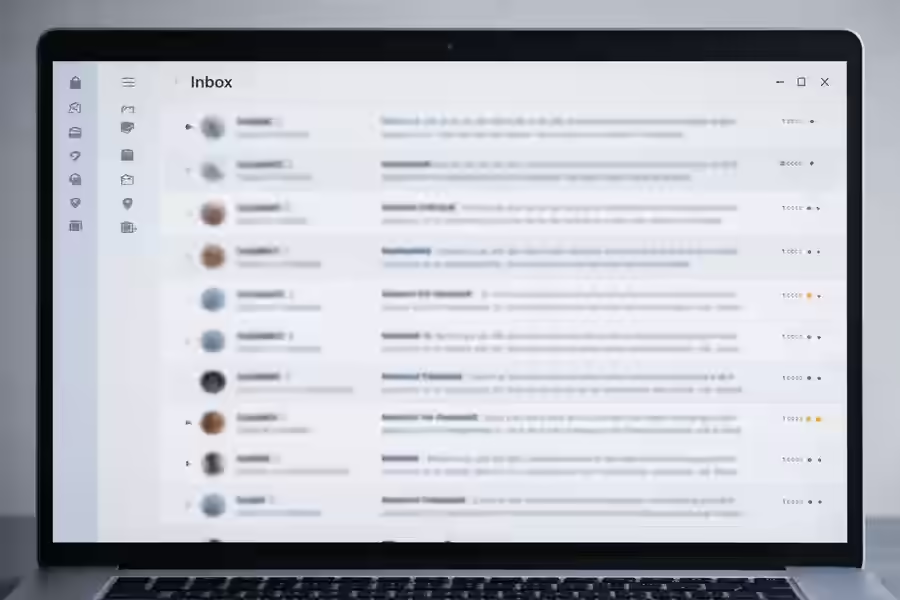
It feels strange to go into someone else’s email, but then you learn its Jeffrey Epstein’s, and you find yourself navigating more than 2,000 leaked messages as if they were part of your daily routine. Jmail turns 20,000 cumbersome government PDFs into an exact replica of Gmail, complete with starred discussions, search bars, and that recognizable red notification dot.
Even when the content is of significant public interest, sorting through massive document dumps is typically a laborious task. This has been the case with emails connected to Jeffrey Epstein, which have made their way into the public domain as scanned PDFs, plain text files, and pictures made public via official disclosures and court actions. That experience is completely altered by a recent web initiative.
It makes the archive feel like a real inbox and transforms a disorganized collection of papers into something much simpler to browse, search, and comprehend by presenting the emails inside a recognizable, Gmail style interface rather than requiring readers to switch between files.
The project, called Jmail, uses solely publicly available content to replicate the appearance and functionality of Google email service. Private access is not involved, nor is there any new data. Making current records readable without the need for specialized tools or hours of manual sorting is the goal, not revelation.
This popular program was created by San Francisco coders Riley Walz and Luke Igel to make the House Oversight Committee document dump searchable, something bureaucrats were unable to do.
Here, the technological prowess is worthy of praise. Every scanned document is processed by Google Gemini AI using OCR to retrieve text that would otherwise be stuck in image files.
Verification links link each email to its original PDF scan, and users can search for Trump or Bezos as if they were looking through their own communications. This avoids AI hallucinations, which is an important precaution when handling evidence that can support legitimate investigations or conspiracy theories.
Users star standout messages, creating a greatest-hits collection of disturbing correspondence.
Community features turn document diving into collaborative investigation. Starred emails surface gems like Epstein’s brother asking Steve Bannon about Putin has the photos of Trump blowing Bubba? the kind of message that would break normal inboxes.
The crowdsourced approach helps users navigate content that ranges from mundane scheduling to potentially explosive revelations, though the authenticity of such inflammatory claims remains under scrutiny. San Francisco’s parking cop tracker’s developers bring their trademark mayhem to public records.
Walz and Igel have earned a living by transforming bureaucratic nightmares into products that are easy to use. Their prior successes, which combine technical expertise with dark comedy, include tracking parking enforcement agents and creating generic YouTube titles.
Although COURIER Newsroom used Google Pinpoint to create a supplementary searchable database, Jmail’s Gmail interface is superior in terms of user experience. While government organizations continue to struggle with basic digital accessibility, the timing takes advantage of public curiosity.
In the most contentious tech initiative of the year, brilliant data visualization collides with unsettling subject matter. Jmail is a prime example of cursed tech unquestionably clever technology encased in painful content.
The tool raises concerns about how we strike a balance between transparency and moral presentation by democratizing access to materials that would otherwise require hours of PDF excavation. Projects like Jmail push us to consider if making everything searchable always serves the public interest as AI continues to change how we use public records.
Who built Jmail and what they were trying to prove
Working with web developer Luke Igel, Riley Walz described by Wired as a prankster and internet artist created Jmail. The two regarded the Epstein emails as both a technical challenge and a culture issue, as opposed to viewing them as unprocessed evidence to be mined for fresh insights.
Their main concern was not what was in the emails, but rather how the presentation of information influences who reads it and who doesn’t. Jmail’s designers have presented it as an accessibility experiment.
They contend that public records are frequently technically accessible but essentially useless, hidden in disjointed files that discourage careful examination. They want to highlight the discrepancy between openness in theory and transparency in reality by reconstructing the archive in a recognizable format.
How the inbox changes the reading experience
A typical email client’s conventions are mirrored in the interface. Conversations are organized into threads, messages are clearly separated into sent and received folders, and a search box enables users to quickly look for people, dates, and keywords.
The way the material can be explored is significantly changed by these minor design choices. Users can easily follow timelines and correspondence patterns rather than skimming individual documents.
This enhances the amount of time available for analysis and decreases the amount of time spent on basic organization for academics and journalists. The familiar layout increases the likelihood of engagement for general readers by removing the intimidating element that frequently accompanies massive document dumps.
Also Read: Valentine’s Week 2026 – All 7 Days From Rose Day, Kiss Day to Propose Day
Jmail is more of a research tool than a gimmick, even though the presentation can feel controversial. It makes no claims about uncovering secret content or introducing fresh information or private data. It is important because it shows how interface design can affect whether public records are disregarded, misinterpreted, or thoroughly investigated.