
In general, the Union Budget 2026 is oriented at the infrastructure development, manufacturing development, simplification of taxes and decreasing the amount of imports, with sustaining the course towards fiscal soundness.
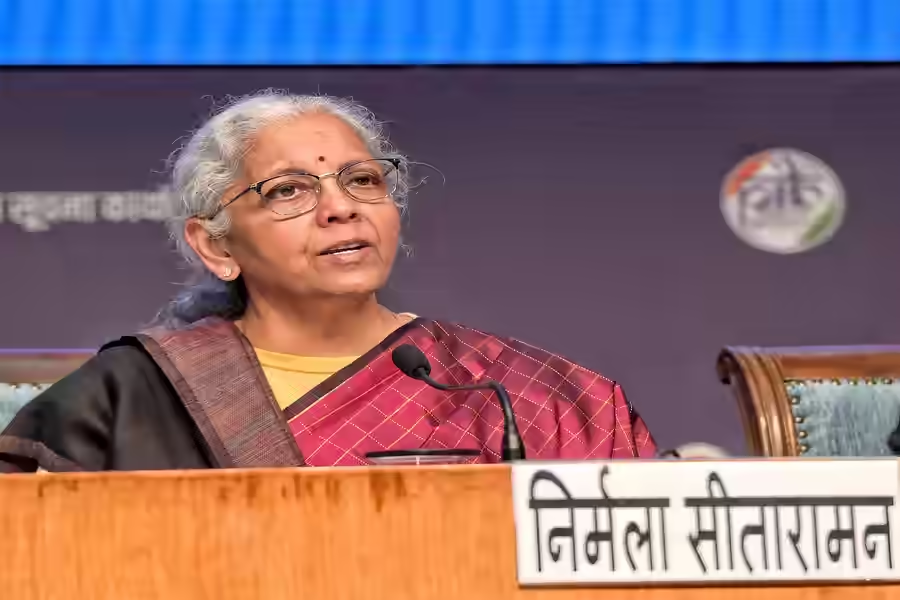
Union Finance Minister Nirmala Sitharaman is delivering her ninth straight Union Budget today, becoming the first finance minister in the history of India to present nine consecutive budgets. She now approaches the total of ten budgets offered by former Prime Minister Morarji Desai, but his too were not sequential.
The Union Budget is presented on a Sunday, the first in the history of independent India. Although markets have typically been closed, the BSE and NSE are conducting special trading sessions so that traders can respond instantly.
The Budget this year is aimed at the shift to the New Income Tax Act, 2025, which will replace the 1961 Act as of April 1, 2026. Infrastructure, railways, defence and artificial intelligence are expected to spend big. Hopeful benefits are also expected among middle-class taxpayers, such as an increase in standard deduction and potentially in the Section 87A rebate.
13:41 IST- Haryana CM Declares Budget a Glad Day to Everyone
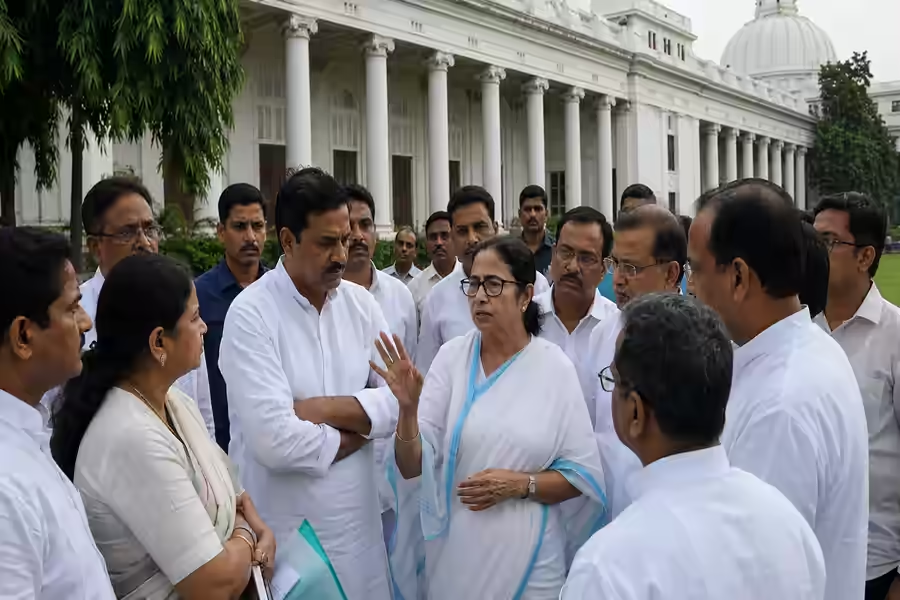
Nayab Singh Saini, the Chief Minister of Haryana, termed the Union Budget 2026-27 as the key to realising the vision of Prime Minister Narendra Modi of a developed India by 2047. By describing it as a visionary and historic document, he indicated that the Budget is heavily concerned about the welfare of the poor and the underprivileged. Addressing the Guru Ravidas Jayanti, Saini pointed out that the financial plan is based on three pillars that are: speed in development, increasing national capacity and inclusive growth that includes all sections of the society.
13:40 IST -Large Rise in Defence Budget
The Union government has given the financial year 2026-27 allocations to the defence ministry that amount to 7.8 lakh crore, which is 15 per cent higher than the previous year. A large amount of money of Rs 2.19 lakh crore, has been allocated to capital outlay to modernise the armed forces.
This comes with the acquisition of high-tech fighter planes, subs, and unmanned aircraft. Rs 1.71 lakh crore has been given to defense pensions. The Budget also suggests exemptions of customs duty on raw materials that are to be used in the production of aircraft parts to improve maintenance and repair in the defence sector, which will be a boost to the local defence production.
The adjustment involved increasing the amount used in capital spending and decreasing the fiscal deficit target. In her ninth consecutive Budget presentation, Finance Minister Nirmala Sitharaman raised the amount of capital expenditure to be incurred in FY27 to Rs 12.2 lakh crore (as compared to FY26), which is higher than the current year target of Rs 11.2 lakh crore.
The government targets to cut the fiscal deficit to 4.3 percent of GDP, which is an indication of further growth drive and fiscal restraint. The overall amount of the Budget is 53.5 lakh crore, whereas the amount of the net tax receipts is estimated at 28.7 lakh crore.
13:33 IST -Big Push Healthcare Workforce
As part of the efforts to empower India healthcare system, the government has decided to educate one lakh allied health professionals within a period of five years. Some of the areas that these professionals will be skilled in include optometry, radiology, anaesthesia, operation theatre technology and applied psychology.
The institutions will also be modernized and new ones created both in the public and in the private sector. In tandem with it, 1.5 lakh multi-skilled caregivers shall be trained to facilitate the elderly care, wellness services, and usage of assistive medical devices.
13:30 IST – in favour of Labour-Intensive Export Sectors
The government announced relief programs for seafood, leather, and textile exporters in an attempt to help them counter the global pressure in trade. The limit of the duty drawback of seafood processing is also increased, and the benefits of duty-free imports are expanded to cover shoe uppers. The time frame of exporting leather products and textile products has also increased; it gives the exporters more time to blend them and also reduces the burden on compliance.
13:24 IST -Cut in Allocation of Lokpal
The anti-corruption ombudsman Lokpal has been assigned a budget of 30 crore in 2026-27, which is lower than the expenditure has been in the previous year. In the meantime, the Central Vigilance Commission was allocated Rs 54.56 crore to assist it in its endeavor to bring transparency and accountability in government.
13:21 IST- Cancer and Rare Disease Drugs -Duty on the Cancer and rare disease drugs waived
Customs duty on 17 cancer drugs and medicines to treat seven rare diseases has been waived in a big relief to the patients.
Other initiatives by the government include Biopharma Shakti whose main goal is to boost biotechnology and pharmaceutical research, innovation, and production by allocating Rs 10,000 crore. It is planned to increase the capacity of the district hospitals by 50 percent, and to form regional healthcare centers in order to facilitate medical tourism.
13:19 IST -Rural Economy and Allied Activities receive impetus
The Budget is aimed at diversifying the rural income by livestock, fisheries and high value crops. Close to 20,000 veterinary experts will be incorporated on a subsidy based program to enhance animal health services.
The fisheries infrastructure will be improved both at the reservoirs and coastal regions and special programmes will encourage planting of coconuts, cashews, cocoa, sandals, sandalwood and high density orchards in hilly areas.
13:15 IST -The Focus on Creative Industries
Following the realisation of economic opportunities held by the creative industry, Sitharaman declared assistance of the Animation, Visual Effects, Gaming, and Comics industry. With thousands of schools and colleges, Content Creator Labs will be established to train the youth to work in new creative jobs. A new National Institute of Design will be also instituted in eastern India.
13:12 IST – Relief for SEZ Units
This will be a single measure that will enable qualified manufacturing units in Special Economic Zones to sell some of their products in the local market at reduced duty rates. This will be done to assist the units experiencing underutilisation because of global trade shocks.
13:08 IST – Delhi CM Praises Budget
The Chief Minister of Delhi, Rekha Gupta, was happy with the Budget, given that it was a demonstration of Viksit Bharat 2047. She valued the emphasis on the employment of youth, development of businesses and the development of cultural heritage.
13:03 IST – Girl Child Hostels and Retail Initiatives by Women
The government recommended the building of a hostel of girls in all districts to promote education by women particularly in science and research studies. As well, She MARTS will be developed as community-owned retail outlets to enable women entrepreneurs and self-help groups to get access to superior markets and brand awareness.
13:00 IST – Capex To Reside As Growth Motor
The high level of capital expenditure allocation will keep on growing the infrastructure and economic momentum, as observed by industry observers. The focus on state investment, as well as the targeted welfare and sectoral reform, is an indication of the government in its desire to strike a balance between development and encompassing.
In general, the Union Budget 202627 is based on a development strategy and is broad-based as it entails increasing state funding, broadening the healthcare sector, rural development, modernising defence, and supporting women, young people and new industries.
13:19 IST
The 2026 Union Budget laid a heavy emphasis on the improvement of the healthcare sector in India. The finance minister Nirmala Sitharaman announced the waiver of custom duty on 17 essential cancer drugs as well as offered relief on duty paid on drugs used to treat seven rare diseases. These measures would be taken to lessen the economic weight on the patients in need of life saving treatment.
The government additionally introduced Biopharma Shakti, a 10,000 crore project that would be distributed over a period of five years to encourage research, innovation and production in the fields of biotechnology and pharmaceuticals. In order to solve the workforce shortages, the Budget sought to train one lakh allied health professionals in fields like radiology, optometry, anaesthesia and applied psychology. Moreover, 1.5 lakh multi skilled caregivers will be oriented in elder care, wellness and use of medical assistive devices.
Five regional medical hubs will be created involving the participation of the private sector in order to enhance medical tourism. These centres will encompass AYUSH centres, diagnostics, rehabilitation and research.
Three new All India Institutes of Ayurveda, modernised AYUSH pharmacies and testing laboratories, and additional funding to the WHO Global Traditional Medicine Centre in Jamnagar will help to combine traditional medicine. NIMHANS 2.0 were also announced in North India and a 50 percent increase in the capacity of the district hospital with new emergency and trauma care centres.
13:15 IST
The Budget introduced policies to increase the rural incomes through livestock, fisheries and high-value agriculture. Livestock is now the main contributor to farm revenues, with Sitharaman declaring a subsidy scheme tied to loan schemes for capital additions that would bring in more than 20,000 veterinary staff. It will also support private veterinary colleges, hospitals, diagnostic labs and breeding centres.
A subsidy programme based on credit will facilitate the creation of businesses in the animal husbandry sector and modernisation of dairies, poultry and livestock businesses. In the case of fisheries, 500 reservoirs and Amrit Sarovars will be built, and coastal value chains enhanced by startups, women led groups and Fish Farmers Producer Organisation.
There is the coconut plantation renewal scheme, cashew and cocoa production and export programmes and sandalwood cultivation and processing support. The old orchards will be revitalized in the hilly regions and high density walnut, almonds and pines cultivation will be increased with priority given to youth entrepreneurships.
13:12 IST
As part of the effort to facilitate manufacturing, the Finance Minister suggested that eligible Special Economic Zone units would be allowed through a one time measure to sell goods in the domestic market at concessional duty rates. This is meant to assist units that are experiencing underutilised capacity as a result of global trade shocks. There will be a limit to the amount of sales allocated to exports and regulatory protection will be introduced.
13:08 IST
The Budget was received with welcoming remarks by Delhi Chief Minister Rekha Gupta whose Budget she claimed would see the vision of a developed India by 2047 by Prime Minister Narendra Modi. She complimented the emphasis on creating employment opportunities among the young generation and the initiatives to enhance cultural heritage and tourism as two major growth accelerants.
13:03 IST
Sitharaman also suggested measures to encourage women education and entrepreneurship. Each district will have a girls hostel to assist women to undertake higher education especially in science and technology. The Budget also launched She MARTS, which is community owned retail stores aimed at assisting the women entrepreneurs to get more access to the market and move out of the small livelihoods to sustainable business ventures.
At the skills levels, the government declared to support the creative industries of India commonly referred to as the orange economy. AVGC Content Creator Labs will be established in 15000 secondary schools and 500 colleges to develop talent in animation and visual effects, gaming and comics. In eastern India, a new National Institute of Design should be created to overcome the lack of trained designers.
13:00 IST
According to rating agency Crisil, the capital expenditure programme of Rs 12.2 lakh crore is approximately 3.1 percent of the GDP in the following fiscal year. Further capital creation grants might also increase the levels of public investment.
12:57 IST
The Budget was criticised by the Congress leader Jairam Ramesh, who termed it as pitifully below the hype. He claimed that the plans looked watered down and not transparent, as real allocations of key plans were concerned.
On the whole, the Union Budget 2026 with its expansion of the health sector, diversification of rural incomes, women-oriented programs, attention to creative sectors and efforts to empower the production process attracted both positive and negative political assessments.
12:52 PM IST
Trinamool Congress MP Saugata Roy criticised the Union Budget 2026 saying it was disappointing and not setting new direction. Roy spoke to the reporters and said that the Finance Minister had merely reiterated past programs and not come up with new ideas. He had also alleged that each state was given nothing special in the Budget and that West Bengal in particular had been neglected.
12:50 PM IST
Indian fishermen who work beyond the territorial waters of the country were offered relief measures by the finance minister, Nirmala Sitharaman. The Indian vessels that catch fish in the exclusive economic zone or in the high seas will no longer be subject to customs duty. Moreover, when the said fish is landed in a foreign port, the said fish will be considered an export. The government stated that safeguards will be put in place to curb the abuse in the course of fishing, transit or transhipment.
12:48 PM IST
Finance Minister increased the capital expenditure target in the coming financial year by 12.2 lakh crore compared with the 11.2 lakh crore in the current year. The 2026-27 fiscal deficit is estimated at 4.3 percent of GDP, which is a little smaller than the estimated 4.4 percent in this year. The Union Budget has been fixed at 53.5 lakh crore. Of this, one point four lakh crore will be divided among other states in the form of tax devolution and net tax receipts are estimated at 28.7 lakh crore. Sitharaman also affirmed that the new Act of Income Tax will also take effect on April 1, 2026, as stated in the new Income Tax Act, 2025.
12:48 PM IST
The government also stated that they would support states to establish three special chemical parks that would operate through a cluster based plug and play. This action is to enhance home-based production, decrease reliance on imports, and enhance manufacturing chains of industries. Moreover, Odisha, Kerala, Andhra Pradesh, and Tamil Nadu will become the rare earth corridors to facilitate mining, processing, and production of strategic minerals.
12:44 PM IST
To alleviate the pressure on the patients, particularly those under cancer care, the Finance Minister suggested the removal of basic customs duty on 17 vital medicines. She further extended the list of conditions that qualify exemption of customs duties on personal imports of medicines and special medical foods by the addition of seven more rare diseases.
12:42 PM IST
The Budget brought about a number of changes in taxation. The buyback proceeds that shareholders will receive will now be taxed as capital gains. The commodity future Securities Transaction Tax has been raised by 0.02 percent to 0.05 percent. In the meantime, the rate of Minimum Alternate Tax has been dropped to 14 percent (previously it was 15 percent) and will be considered as the ultimate tax amount.
12:38 PM IST
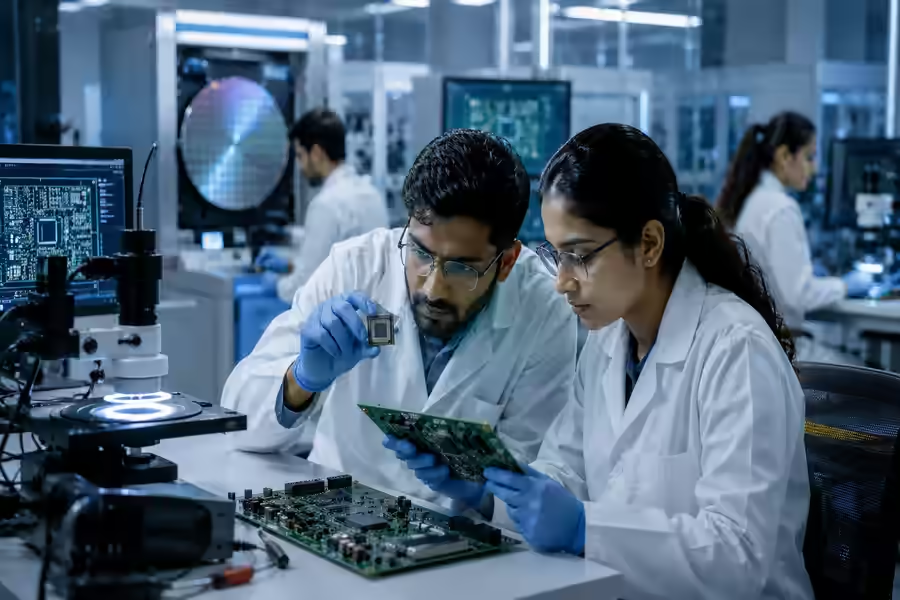
The amount of outlay on Electronics Components Manufacturing Scheme has also been raised to Rs 40, 000 crore compared to the previous Rs 22, 999 crore. Another step, which was announced by the government, was the new version of ISM 2.0, which is supposed to empower semiconductor manufacturing, equipment manufacturing, and design in India. The aim of these processes is to decrease the level of importation and make India more competitive in production of high technology.
12:34 PM IST
The duty on customs will be exempted on the importation of raw materials to be manufactured into aircraft parts, which will be used in maintaining, repairing, and overhauling of the aircrafts by the defence sector units. This will increase production of defence in the country and the dependence on imported products will be low.
12:32 PM IST
The Finance Minister suggested that there should be the exemption of a basic customs duty on capital goods necessary to process the critical minerals in India. This is done to enhance domestic strategic mineral processing.
12:32 PM IST
The government has also been offering customs duty exemption on imports needed to do nuclear power projects until 2035. The favor will now cut across all the nuclear generation plants, irrespective of their megawatts.
12:27 PM IST
In order to facilitate export, the extent of duty free imported of particular inputs to be used in processing of seafood has been raised to 3 percent of last year export worth. The same has also been applied to exports of shoe upper which had previously covered only leather and synthetic footwear.
12:24 PM IST
Sitharaman affirmed that the Income tax Act, 2025, will be in effect by April 1 2026. Soon simplified tax regulations and redone income tax returns forms will be announced. The new law simplifies the system, eliminates obsolete provisions and the new law adopts only one tax year. It also enables taxpayers to receive refunds on TDS without any penalties even in case the returns are late.
12:22 PM IST
The Finance Minister suggested establishing rare earth corridors in Odisha, Andhra Pradesh, Tamil Nadu and Kerala. These pathways will serve mining, processing, research and manufacture of rare earth elements which are essential in clean energy, electronics, defence, and electric vehicles.
12:21 PM IST
To emphasize the fiscal prudence of the government, Sitharaman indicated that the fiscal deficit target of 4.3 percent indicates that the government intends to continue lowering the central government debt to GDP ratio. The general government debt in 2024 was approximately 85 percent of GDP of which 57 percent was vested in the central government.
Government Finances and Fiscal Deficit
The projected fiscal deficit in 2026-27 is 4.3 per cent of GDP by the government, which is a bit less than in the prior year. There will also be an improvement in the debt-to-GDP ratio. It is estimated that total government expenditure amounts to Rs 53.5 lakh crore, and non-debt receipts will be 36.5 lakh crore. The Centre is estimated to get net tax receipts of Rs 28.7 lakh crore.
Changes in Income Tax Filing
The government has presented a phased filing of income tax returns. Those who utilize ITR-1 and ITR-2 will also have a deadline of July 31. Nevertheless, the deadline for businesses that do not need audit and trusts will now extend to August 31 to submit their returns.
New Income Tax Act from 2026
The new Income Tax Act shall take effect on April 1, 2026. It will consist of easier rules, redone forms and various relief provisions. The source tax on overseas tour packages and on foreign remittances to fund education and medical requirements shall be cut down to 2 per cent. Individuals have had interest earned on motor accident compensation, which will not be subject to taxation. It will also be made clear that some manpower service payments will come under TDS rules to eliminate confusion.
Healthcare and Medical Sector Push
More than 1,000 accredited clinical trial sites will be established in India by the government. India as a global healthcare destination will also be marketed by developing five regional medical tourism hubs. Biopharma Shakti programme of Rs 10,000 crore will encourage local manufacture of biologics and biosimilars. Three new National Institutes of Pharmaceutical Education and Research will be established and seven others refurbished.
Technology and AI proponents
Artificial intelligence and new technologies are also a priority. To enhance innovation, the government is funding AI missions, the National Quantum Mission and research funds. A Bharat Vistar multilingual AI will be introduced to assist with the integration of agriculture data. New labs in schools and colleges will be used to support the AVGC industry which comprises animation and gaming.
Green Energy and Climate
A five year outlay of Rs 20,000 crore has been submitted on Carbon Capture, Utilization and Storage technologies. This will also assist industries in decreasing emissions and assist India in its climate targets.
MSMEs and Manufacturing
Micro, small and medium enterprises will be assisted greatly. A SME Growth Fund of 10,000 crores will be established. Self Reliant India Fund will receive an extra amount of Rs 2,000 crore in order to assist micro enterprises in accessing risk capital. It will also require the government to require central public sector units to pay MSMEs using the TReds platform to enhance liquidity.
Another area of focus is manufacturing. India Semiconductor Mission 2.0 has been initiated at the cost of Rs 40,000 crore. It will facilitate manufacturing, supply and design of chips. Another Shakti program worth Rs 10,000 crore will enhance the semiconductor ecosystem even more.
Infrastructure and Rail
Capital spending 202627 is suggested to be at 12.2 lakh crore to sustain the infrastructure push. There will be seven high-speed rail corridors. Proposals of a new freight route between Dankuni in the east and Surat in the west have also been floated to enhance the flow of cargo.
Defence and Strategic Sectors
Defence expenditure is still a priority in the face of global tensions. The government is also considering promoting rare earth mineral corridors in Odisha, Kerala, Andhra Pradesh and Tamil Nadu to limit reliance on imports.
Overall Economic Direction
The Finance Minister joined in saying the government is still focused on stability through reform not rhetoric and is geared to growth. India is on course to become a developed country through the Viksit Bharat vision, despite the problems in global trade and supply chain disruptions.
This Budget is being viewed as a growth, job creation, manufacturing, and technological development road map, and is also attempting to keep fiscal discipline and give taxpayers relief.
Union Finance Minister Nirmala Sitharaman is delivering her ninth straight Union Budget today, becoming the first finance minister in the history of India to present nine consecutive budgets. She now approaches the total of ten budgets offered by former Prime Minister Morarji Desai, but his too were not sequential.
The Union Budget is presented on a Sunday, the first in the history of independent India. Although markets have typically been closed, the BSE and NSE are conducting special trading sessions so that traders can respond instantly.
Also Read: Gold Price Weakens Ahead of Union Budget 2026 as Sellers Take Profit
The Budget this year is aimed at the shift to the New Income Tax Act, 2025, which will replace the 1961 Act as of April 1, 2026. Infrastructure, railways, defence and artificial intelligence are expected to spend big. Hopeful benefits are also expected among middle-class taxpayers, such as an increase in standard deduction and potentially in the Section 87A rebate.
Image courtesy: PIB