
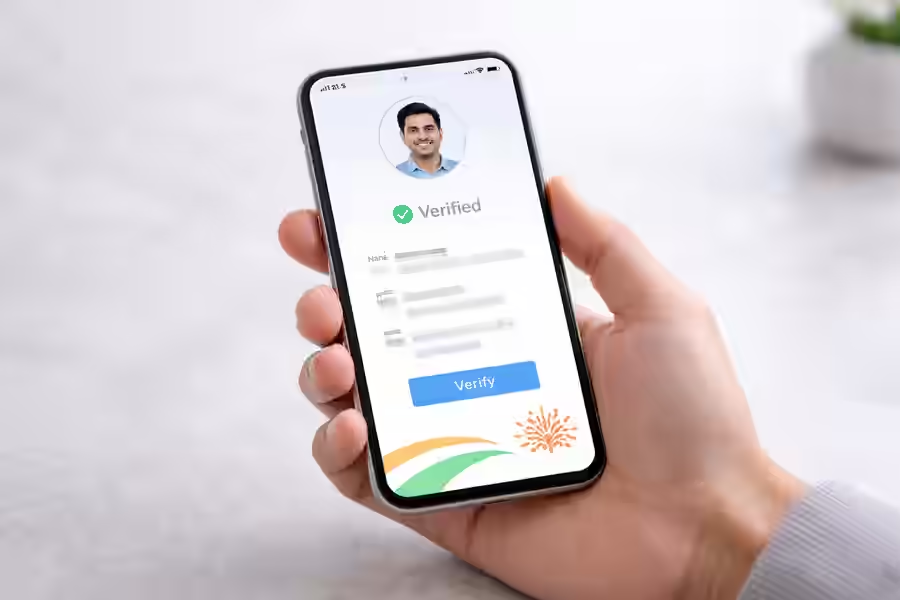
Another stride India is going towards privacy-conscious use of digital identities is the introduction of a new Aadhaar mobile application to the Unique Identification Authority of India (UIDAI). The application will enhance the security, paperless nature, and compatibility of identity verification, as well as reducing the volume of personal information disclosed, with the Digital Personal Data Protection (DPDP) Act.
One of the main peculiarities of the new app is that it allows to verify age verification without exposing the superfluous personal information. At the launch, Electronics and IT Secretary S. Krishnan clarified that age verification has been one of the significant issues under the DPDP Act, particularly in websites where restriction of services according to age is required.
The Aadhaar application can be used to identify a solution, using what is referred to as the age gating whereby the age of an individual can be verified digitally without revealing the complete date of birth or other personal information.
This feature should come in handy especially on social media networks, online gaming services, and e-commerce websites that need to make sure that children do not get access to age-restricted contents and products. With the help of Aadhaar-based authentication in a privacy-centric approach, businesses can comply with the regulatory obligations and minimize the risk of excessive user data harvesting.
The government has revised the Aadhaar Authentication for Good Governance (Social Welfare, Innovation, Knowledge) Rules, 2020, popularly known as the Swik Rules to support this broader application. The amendment provides a secure and regulated access of Aadhaar authentication by private entities in the provision of services, which is a broader scope than government welfare schemes.
The new Aadhaar app can be downloaded on mobile app stores and is designed to substitute the prevalence among the photocopies and printed Aadhaar cards in identity checks. Hotels, movie theatres, event places and other service providers will be in a position to verify individuals digitally using the app, eliminating the need to handle or store physical versions of Aadhaar.
This is important since the Aadhaar Act does not permit storing of Aadhaar information, including photocopies, in the hands of private entities, a provision that has proven to be typically broken in practice because of absence of easy alternatives.
UIDAI CEO Bhuvnesh Kumar pointed out that the app is not just verification but also enhancing the access to Aadhaar-related services. The customers can now change their mobile number directly on the app without attending an Aadhaar centre. The application has also incorporated address update facilities which were already in place on the internet so as to access it easily.
The other useful functionality is a digital contact card, a function that enables users to exchange minimal contact details without handing over paper cards or other identity documents. This provides an added convenience in normal interactions whilst limiting the sharing of personal data.
Notably, the application can be used to add up to five profiles to the Aadhaar holder (e.g., the children or other parents who are older and might not have their own mobile numbers). Such a feature will enable families to perform digital authentication of traveling, events, or other services without carrying various physical documents.
Also Read: TikTok Influencer Alina Amir’s Viral MMS Deepfake Explained as She Breaks Her Silence
It is supposed to come in handy especially in such areas as airports, movie theatres and social areas where identity verification is being the order of the day.
In a nutshell, the new Aadhaar app indicates a change towards more privacy conscious online governance. UIDAI will bring Aadhaar usage into correlation with the provisions of the DPDP Act by facilitating the limited and purpose-specific data sharing and by discouraging the use of physical copies.
The app, once popular, can decrease the number of cases of data misuse, streamline the verification process, and increase confidence in the digital identity ecosystem in India.