

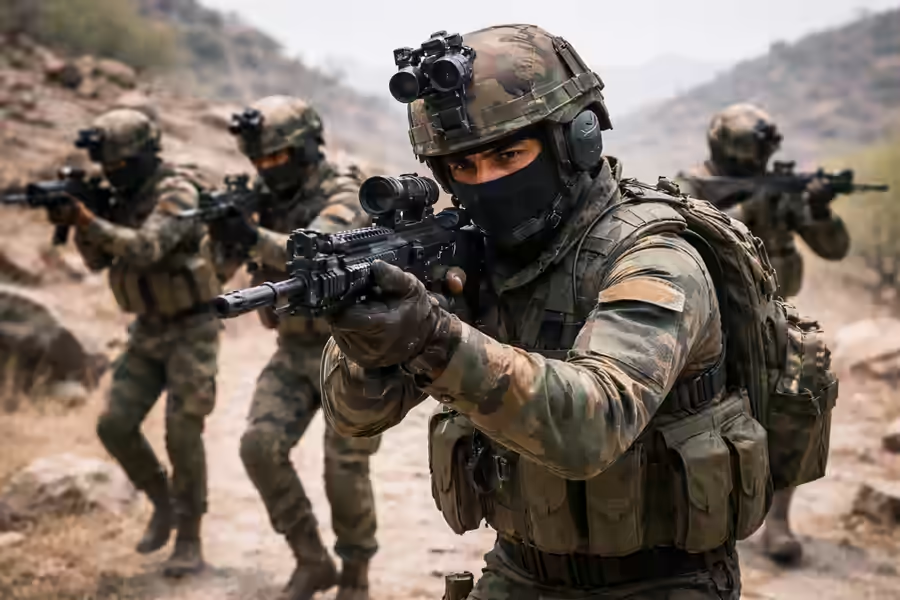
In the 77th Republic Day parade, the Indian Army unveiled a new fighting unit, the Bhairav Battalion, the first time a public display of what officials termed as a fast, high quality light commando unit, was deployed to meet the modern security demands.
The unit is configured to be deployed quickly and highly mobile, and reflects the shift toward the Army moving towards preparing against emerging threats in the grey zone that are not full scale war but still require the rapid and precise response.
The Sikh Light infantry Regiment 4 Bhairav Battalion participated in the parade, as one of the 4 Bhairav Battalions of the Sikh Light infantry regiment which are operational in combat gear and tightly packed formation.
A Bhairav unit is quite small, in contrast to typical infantry battalions of 800 to 900 soldiers; it has approximately 250 members. This lean organization enables the battalion to be fast moving, independent and reactive to immediate threats, particularly across sensitive borderlines.
According to military planners, the Bhairav battalions were established to fill the gap between the traditional infantry and the high-quality special forces like the para Special Forces. As regular infantry is to perform sustained operations and larger scale engagements, and the special forces are supposed to perform missions of high specialisation,
Bhairav units are supposed to deal with tactical situations that are highly dynamic and demand speed, maneuverability, and technological convergence. The Bhairav name was inspired by the incarnation of a ferocious incarnation of Lord Shiva, which symbolizes power, vigilance and security.
The new force has been referred to by army officials as a force that is invisible but invincible because it can work silently but who can take decisive action where the action is needed. The battalion also represents the idea of the Sant Sipahi the warrior who is disciplined and calm but capable of the battle as well.
The concept of the Bhairav battalion has one unusual aspect, the Sons of the Soil movement. In some units, the soldiers are recruited among the regions where they are likely to go.
This provides them with an acquaintance to local terrain, climate, and conditions, and this can be especially important in high-altitude, desert, or rough border conditions where rapid knowledge of the area can dictate the success of the missions.
The Bhairav battalion is highly involved in technology. Apart from being trained in the use of sophisticated infantry strategies, these soldiers are also taught to use modern weaponry of the battlefield.
Units are prepared with drone surveillance, advanced communication and air defence equipment and electronic assistance. In some teams, specialists in signals, electronics, and artillery coordination are combined in one and very small force.
The Army has a strategy of increasing approximately 25 Bhairav battalions in installments, and some of them are already deployed in other areas of strategic relevance, such as the Northern Command sectors. These places have high mountain passes and sensitive frontiers which demand forces capable of reacting quickly to the dynamic situations on the ground.
Also Read: Invest in India’s Energy Sector – $500 Bn Opportunity, Says PM Modi
Although the Bhairav battalions introduce a new dimension to the military posture of India, it is not supposed to substitute the current elite formations.
They should, instead, be deployed to work collectively with special forces and regular infantry, enhancing the capacity of the Army to respond to a broad spectrum of threats in a prompt, accurate, and flexible manner.