
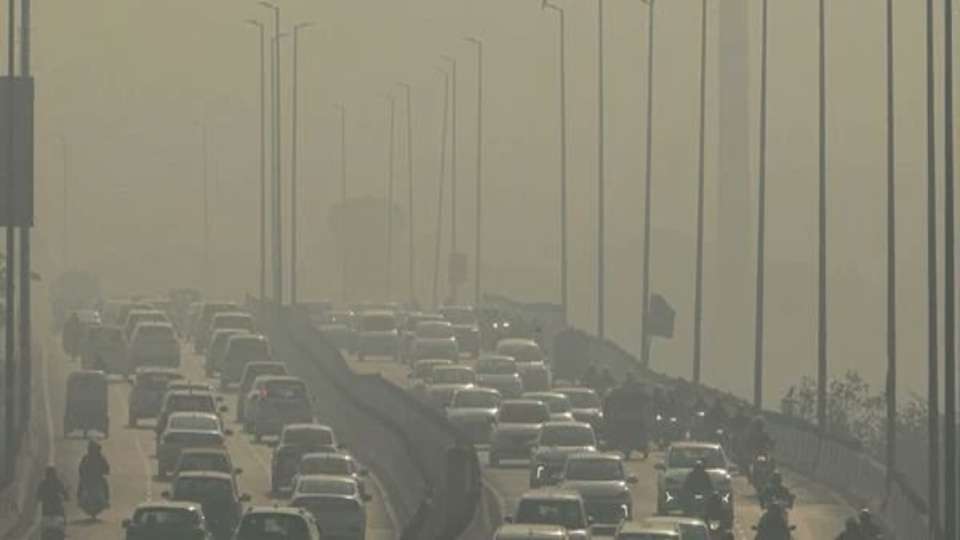
Delhi is once again choking under a thick layer of toxic smog as the Air Quality Index (AQI) crosses past 400 in many parts of the city.
This level falls under the “severe” category, thus means that the air is dangerous even for healthy people. While every winter brings a rise in pollution in Delhi due to weather conditions, this year, many residents are currently pointing fingers at a new problem: which is large-scale tree pruning, which is done by the government agencies and contractors.
According to the citizens and the environmental activists, the heavy trimming of trees and branches has only made the situation worse by reducing natural dust barriers and weakening the city’s green cover.
People who are living in areas like South Delhi, Dwarka, Rohini and Central Delhi have thus also reported seeing long stretches of roads lined with half-cut or bare trees.
These trees used to act as natural shields, thus blocking dust, absorbing varied pollutants and also aiding in releasing oxygen. But after the recent “clean-up drive,” many of them stand just like stumps with barely any leaves.
Residents also say that this unnecessary trimming has thus turned green neighbourhoods into a field of concrete stretches, thus giving dust and smoke an open path to spread in the locality. As a result, pollution levels seem higher, and the air tends to feel heavier and dirtier than usual.
Environmental groups have also argued that pruning should be done only when trees pose a danger, such as old branches falling during storms.
However, in Delhi, pruning is often carried out without the idea of proper scientific guidance. Experts say that cutting too many branches at once damages the tree, slows down its ability to absorb the pollutants in nature and also reduces its overall lifespan.
By harming thousands of trees across the city, the pruning drive may have unintentionally weakened Delhi’s natural defence system just when the city needed it the most.
Doctors are also seeing a rise in breathing problems, coughing, allergies and eye irritation.
Hospitals have thus advised children, the elderly and also the asthma patients to stay indoors as much as possible. Schools are also now facing pressure from parents to shift to online mode again, at least until the air becomes breathable.
Masks, air purifiers and anti-pollution medicines have turned into household necessities.
Image Credit: X/ @bsindia