
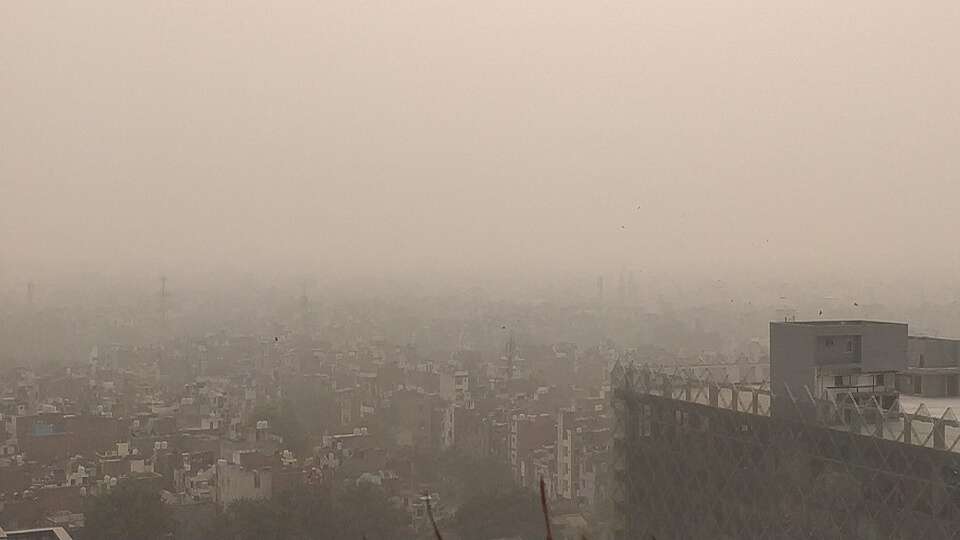
Delhi’s air quality continues to remain in the list of “very poor” category, which has been thus in recording an Air Quality Index (AQI) of 345 on Sunday morning, all of this according to data from the Central Pollution Control Board (CPCB).
Although there has been a slight improvement from the previous days when the AQI touched 360 but still the overall pollution levels continue to remain alarmingly high, which is now the reason for posing serious health risks to residents.
Experts have suggested that this persistent pollution is because of a combination of factors, including all the vehicular emissions, various construction dust, even the stubble burning neighbouring states, and also the uunfavourableweather conditions.
The calm winds and low temperatures have also trapped pollutants close to the ground, which have been resulting in dense smog across Delhi and even the adjoining NCR areas.
Despite all the efforts such as restricting construction work and even due to implementing the odd-even vehicle scheme, the air quality has still been the one that has not shown any significant improvement.
The Delhi government has also now continued enforcing measures under Stage IV of the Graded Response Action Plan (GRAP), all of which include curbs on entry of trucks, bans on types of diesel generators, and even the promotion of public transportation.
Schools have been advised to hold online classes for all the younger students so as to protect them from prolonged exposure to toxic air.
Health experts have thus warned that such pollution levels can cause terrible breathing difficulties, eye irritation, and even be a reason for long-term respiratory problems.
This would be affecting a particular age group, especially for children, the elderly, and those with pre-existing health conditions. They also recommended staying indoors, using air purifiers, and wearing N95 masks when stepping outside.
With winter here being still approaching, meteorologists have also predicted that the air quality may further deteriorate unless there is a significant change in weather patterns or stronger enforcement of anti-pollution measures.
Image credit: Wikimedia