

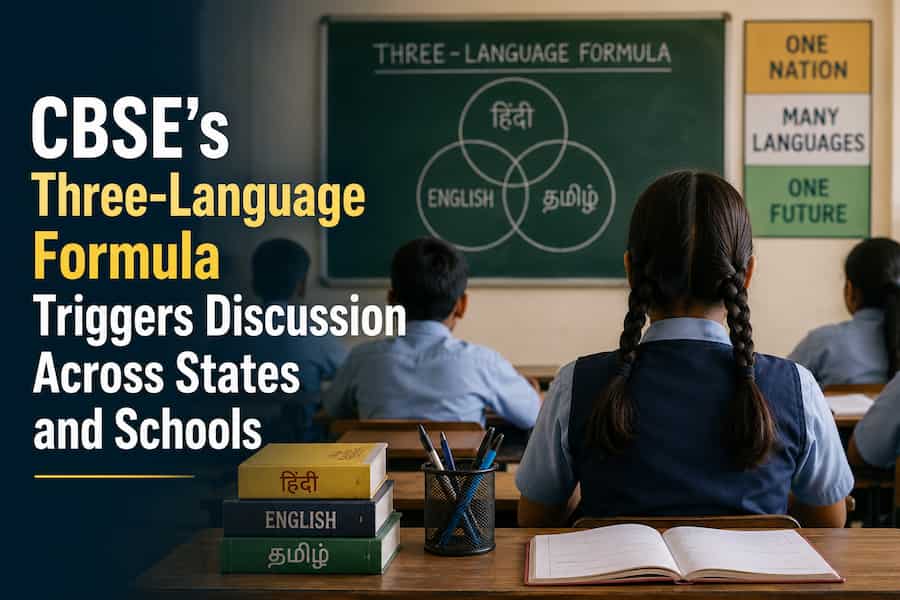
The three-language formula proposed by the CBSE (Central Board of Secondary Education) has gained renewed interest across the country. This educational policy that is consistent with NEP 2020 has the objective of fostering multilingualism among the learners while preserving the linguistic diversity of India.
This is suppose to bring an opportunity for many students whereas for some it may feel like some extra burden being added to already packed schedules. The decision of the Central Board of Secondary Education (CBSE) to make the three-language framework mandatory for Class 9 students, has sparked some debates as well.
While the policy seeks to improve language skills and cultural understanding, its implementation has generated varying reactions from different states, education experts and parent groups.
Those who are in favour of this three language formula say that this can enhance cognitive abilities, improve communication skills and provide students with greater opportunities in higher education and employment. And supporters of this also argue that this will give students a better understanding of India’s diverse cultural landscape.
On the other hand, people are criticising it regarding the practical challenges of implementing the policy. Several states have questioned whether schools have sufficient resources, trained teachers and infrastructure to effectively teach multiple languages, particularly in regions where language preferences differ significantly.
Discussion on the topic has further involved matters exceeding to identity and language. There have been certain uneasiness raised from some states about possible burden of certain languages on regions which would have an impact on their linguistic traditions and educational preferences.
This has led to the subject matter crossing the boundaries of academia and entering politics. That distinction matters because language is never just a subject. It carries history, culture, memory and belonging. For many families, conversations around language are deeply personal.
Also Read: Russia’s Fresh Offensive Across Ukraine Leaves Rescue Teams Racing
Parents and administration in schools have emphasized the importance of developing guidelines for selecting a language and curriculum development and assessment techniques. Several schools are waiting for additional guidelines in order to make the this shift smooth when time comes.
Despite ongoing debates, this three language formula continues to be a major matter in dispute when it comes to reforms in the nation’s education system. It can safely be assumed that continued consultations will be undertaken between policymakers, educators, and regional states.