
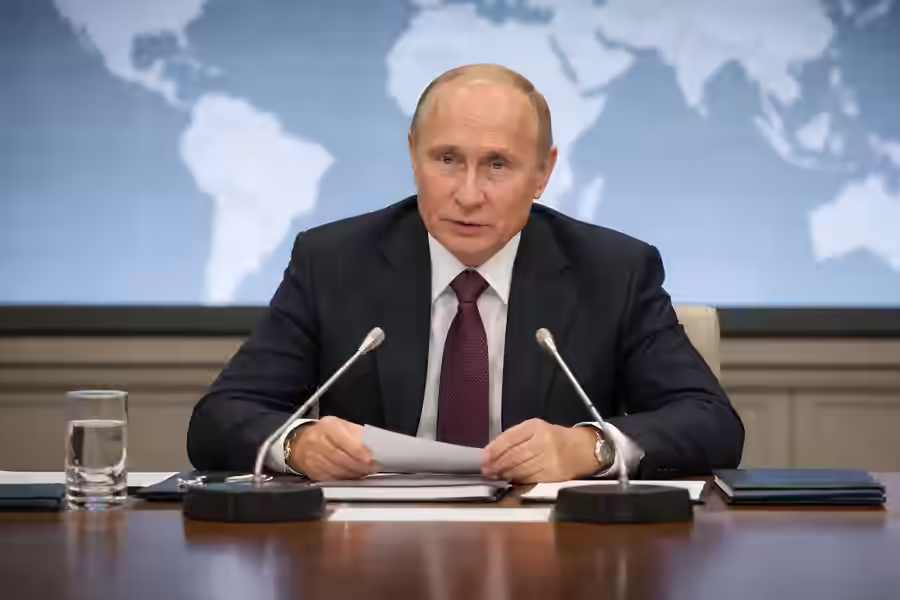
Russian President Vladimir Putin has expressed strong support for Iran’s newly appointed Supreme Leader, Ayatollah Mojtaba Khamenei. In a message sent on Monday, Putin assured Tehran of Russia’s continued partnership and solidarity at a time when Iran is facing major geopolitical challenges.
Mojtaba Khamenei recently took over as Iran’s Supreme Leader after the death of his father, Ali Khamenei, who was killed in strikes carried out by the United States and Israel earlier this month. His appointment comes during a period of intense regional tensions and growing international attention on Iran’s political future.
In his message to the new leader, Putin reaffirmed Russia’s commitment to Iran and its leadership. He said Russia stands firmly with Tehran and its people during this difficult time.
“I would like to reaffirm our unwavering support for Tehran and solidarity with our Iranian friends,” Putin said in the message. He also added that Russia has long been a dependable partner for Iran and will continue to maintain that relationship in the future.
The Russian president emphasized that Mojtaba Khamenei’s leadership will require determination and courage, especially given the current situation in the region. According to Putin, Iran is facing serious challenges and external pressure, making the role of the new Supreme Leader even more significant.
“At a time when Iran is confronting armed aggression, your tenure in this high position will undoubtedly require great courage and dedication,” Putin said.
Russia and Iran have maintained close diplomatic and strategic ties over the years. The two countries have cooperated on several regional and global issues, including energy, trade and security. Putin’s message signals that Moscow intends to continue strengthening this partnership under Iran’s new leadership.
However, the appointment of Mojtaba Khamenei has also drawn criticism from some international leaders, particularly in the United States. Former US President Donald Trump had earlier voiced strong opposition to the possibility of Mojtaba Khamenei taking over the top leadership role in Iran.
Speaking to Axios before the appointment was confirmed, Trump said he did not support the idea of the late leader’s son becoming the next Supreme Leader. “Khamenei’s son is unacceptable to me. We want someone who will bring harmony and peace to Iran,” Trump said.
Trump also made a strong remark regarding the future of Iran’s leadership, warning that the new leader might face difficulties without international acceptance. In another interview with ABC News, he said, “If he doesn’t get approval from us, he’s not going to last long.”
Later, when asked again about the situation, Trump gave a more cautious response and said the world would have to wait and see how events unfold.
Mojtaba Khamenei, who is 56 years old, has largely stayed away from the public spotlight throughout most of his life. Despite being the second-eldest son of the late Supreme Leader Ali Khamenei, he has rarely appeared in public and has maintained a relatively low profile.
Political analysts say that although Mojtaba avoided official titles for many years, he is believed to have held significant influence within Iran’s political and religious establishment behind the scenes.
His rise to the position of Supreme Leader comes at a critical moment for Iran. The country is dealing with rising tensions with the United States and Israel, as well as internal political pressures.
The system of governance established by his father nearly five decades ago is now facing one of the most serious challenges in its history. Observers believe Mojtaba Khamenei’s leadership will play a key role in shaping Iran’s response to both domestic and international pressures in the coming years.
With Russia publicly expressing strong support and Western leaders voicing concerns, Iran’s new leadership is likely to remain a major topic in global politics in the days ahead.